Sean Bagshaw Outdoor Exposure Photography

Images from the edge

See all image results...

Search Criteria
Exact matches only
Search in title
Search in content
Content Type
Select all
Search Posts
Search Prints & Stock Photos
Search Events
Search Pages
  • About
    • Sean’s Biography
    • A Look Through My Lens
    • Social Media
    • Alliances
    • Sign Up For My Newsletter
    • Website Tour
    • Interviews And Podcasts
    • CV
  • Tutorials & TK Photoshop Plugins
  • Learn Nature Photography
  • Videos From My YouTube Channel
  • Signed Prints
    • Favorites Of 2023
    • OREGON
    • CANYONS AND RIVERS
    • CITYSCAPES
    • COASTAL
    • DESERTS AND PRAIRIES
    • FLOWERS AND PLANTS
    • FORESTS AND TREES
    • MOUNTAINS AND LAKES
    • NATIONAL PARKS
    • STREAMS AND WATERFALLS
  • PRINT OPTIONS
  • Stock Photography
    • OREGON
    • NORTH AMERICA
    • THE REST OF THE WORLD
    • AGRICULTURE AND VINEYARD
    • BUILT BY PEOPLE
    • NATURAL BEAUTY
    • OUTDOOR AND ADVENTURE
  • Books & Calendars
    • Calendars
    • Washington Evergreen
    • Oregon, My Oregon
    • Photographing Through The Seasons
  • Workshops
  • Events
  • Photography Blog
  • Contact
  •  

Fun Photography at the Montague Balloon Fair

October 24, 2007 by Sean Bagshaw Leave a Comment

Fun Photography at the Montague Balloon Fair
balloon fair

A year ago I was traveling through the southwest right about the time of the world famous Albuquerque International Balloon Festival. With as many as 700 colorful hot air balloons taking to the skies it is a big attraction for photographers and I was tempted to add it to my itinerary. However, I had also heard about the crowds, traffic jams, shortage of places to stay and all the other headaches you would expect with any event as big and widely known. I decided to pass.

balloon fair

This year I found a great substitute in the Montague Rotary Balloon Fair in northern California the third week of September. What it lacks in sheer volume of balloons it more than makes up for with a great setting in the Mt. Shasta Valley, friendly organizers and balloon teams, easy access, on sight camping, plentiful parking and minimal crowds. Spectators have access to the launching field and can walk among the balloons during the inflation and launch process, making this an easy photo op for anyone with a camera. Spectators can even volunteer to crew for a balloon team, helping them to inflate and launch as well as chase, land and pack their balloons.

balloon fair

This year about 30 balloons took part in the fair. While a far cry from 700, 30 balloons is still an impressive site and makes for an exhilarating visual and photographic experience. Montague is about seven miles east of Yreka, just off of Interstate 5 in northern California. Montague is less than an hour from where I live in southern Oregon. I was so enthralled photographing the balloons on Friday morning that I returned on Saturday and Sunday as well. I recommend this event to anyone, especially families.

balloon fair

For more information you can visit the balloon fair website at http://clubs.district5110.org/shastavalley/balloonfair/

Filed Under: Past Events, Photography Journal, Photography Travel Journal

Adventure: Climbing Bear Creek Spire

July 31, 2007 by Sean Bagshaw Leave a Comment

Adventure: Climbing Bear Creek Spire
bear creek spire

Galen Rowell was one of the best-known photographers of the last 30 years, and he has been a major influence on me and my photography since the 1990’s. However, before I knew of him as a photographer I was aware of his exploits as a climbing pioneer, first in Yosemite Valley, then in the high Sierra and eventually in the greater ranges around the world. In July my long time climbing partner, Chuck Porter, and I ventured down highway 395 to the east side of the Sierras to try our hand at climbing a classic Galen Rowell route, the North Arete of Bear Creek Spire (5.8, 10 pitches).
Galen climbed the North Arete in the early 1970’s after he decided it was time to take the climbing skills he had developed in Yosemite to the higher reaches of the backcountry.

north arete

To get to Bear Creek Spire we took the Tom’s Place exit off of Hwy. 395 south of Mammoth Lakes and followed Rock Creek Road up to Mosquito Flat. At 10,200 feet, the trailhead is one of the highest in the entire range. Chuck and I began our approach at 4:15 AM hoping to be back at the car in the mid afternoon. The first three or four miles of the hike follows flat trails along numerous lakes in the Rock Creek Valley, a popular backpacking destination. The second half of the approach was more difficult, and involved traversing a couple of miles of steeper talus slopes. All along the approach we had excellent views of Bear Creek Spire sitting in its lofty location at the head of the valley.

climb

We reached the base of the North Arete at nearly 13,000 feet by about 8:00 AM. From here we roped up and began climbing the arete from its lowest point. We had hoped to complete the climbing portion of the day in four or five hours, but quickly ran into sections of the climb that were too narrow to climb easily with packs on. This necessitated climbing some short pitches and hauling the packs past the narrow areas. These delays combined with the affects of altitude stretched our time on the rock to eight hours. However, the rock was excellent and the position on the steep buttress was amazing. The weather was warm and stable, so we were not too concerned about being behind schedule.

chuck

Further up we were able to simul-climb the 4th class and easy 5th class ridge to the top. The summit of Bear Creek Spire consists of a small pointed block with only enough room for one person to perch on at a time. Chuck carefully made the last few moves and pulled himself up to stand on the highest point in this portion of the Sierra.

ridge

Safely down on the lower angled west side of the mountain we ate our lunch and began the descent, which would prove to be the most strenuous part of the day. The upper part of the descent requires steep down climbing on dangerous loose boulders covered with dirt. Further down the angle lessened and the boulders became more stable, but there was still another three miles of rugged scree fields to cross before reaching the trail. We trudged back to the car right as the last light of the day was fading after 17 hours on the go.

summit

My best landscape photography is often captured in a slow and thoughtful process, spending time finding the right composition and waiting for the right light, as many of Galen’s classic Sierra images were. However, for this trip it was Galen’s love of adventure and climbing that provided inspiration more than his photos. I was more than satisfied with documenting the climb in photographs as best I could while enjoying a day in the mountains with a good friend.

Filed Under: Adventure Journal, Photography Travel Journal

Featured Photo: Prayer Flags in the Fog

June 4, 2007 by Sean Bagshaw 4 Comments

Featured Photo: Prayer Flags in the Fog

prayer flags

This photo was taken at the summit of 17,500-foot Gokyo Ri in the Mt. Everest Region of the Himalayas in Nepal. Gokyo Ri, while much higher than any mountain in the US outside of Alaska is really just a small hill in the Himalayas. It is located above the third lake in the Gokyo Valley which lies directly to the west of the Khumbu Valley, the main drainage leading from the base of Mt. Everest’s south side. From the Gokyo Valley Mt. Everest is obscured from view by a high ridge of peaks running between the two valleys. However, those who make the additional effort to ascent Gokyo Ri are rewarded with a grand view over the intermediate peaks to the world’s highest peak beyond. At least they are when the summit of Gokyo Ri is not enveloped in thick clouds as it was when I arrived. Shivering in the cold wind and physically exhausted by the steep climb at such a high altitude I was disappointed not to see the vista I had been anticipating. However, it was still powerful knowing that I was standing on the brink of a great drop and that the large peaks of the Himalayas spread out beyond my feet. I could almost feel the gravitational pull of Mt. Everest’s huge mass out there in the fog.

Even without the view of the mountains, the strings of Tibetan prayer flags blowing in the swirling wind and fog and isolated from their surroundings created a powerful image in my mind. Despite cold and fatigue I set up my camera and took several shots. I think the one above best captures the sense of windy isolation I experienced on top of Gokyo Ri that day.

On the descent the fog thickened and it began to snow. For a while I lost the trail and veered off course before coming out below the clouds and making my way back to the village at dark.

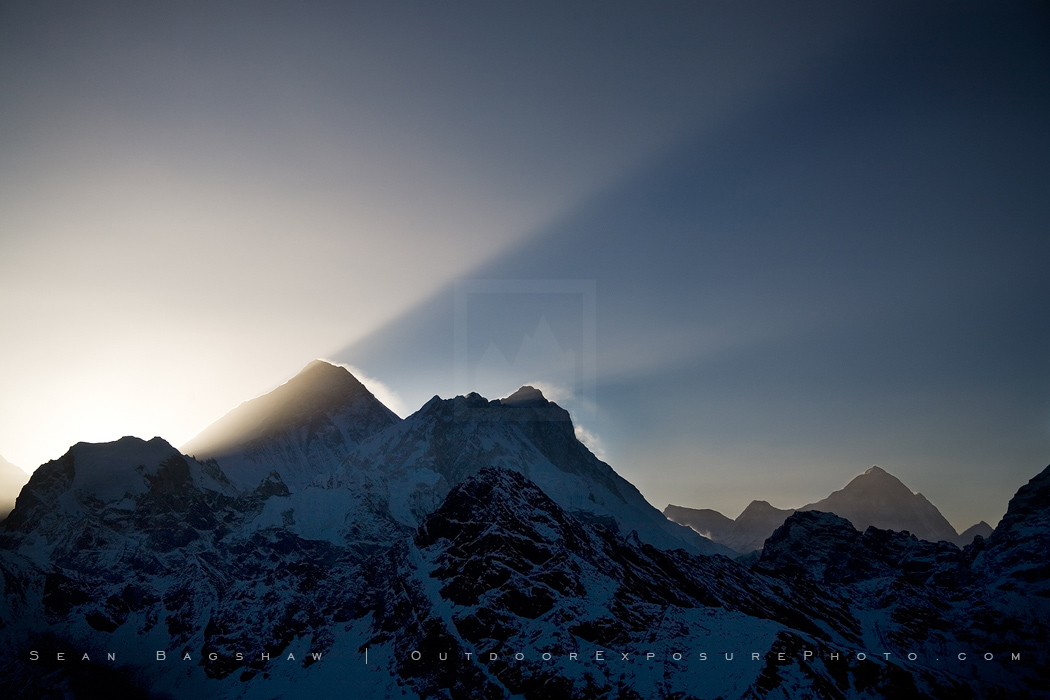
Fortunately I was able to stay in Gokyo for a while longer. Two days later I made the climb again before dawn under clear skies. The sun rose directly behind Mt. Everest sending out rays of light across the valleys and peaks. The second photo is one I took that morning not far from where I had taken the one in the fog two days earlier.

everest

Canon EOS 5D

28-135mm lens

First Image .6 sec @ f/36

Second Image 1/60 sec @ f/6.3 with fill flash

Gitzo Carbon Tripod

Filed Under: Adventure Journal, Featured Photos, Photography Travel Journal

Oregon Waterfalls In The Spring

April 20, 2007 by Sean Bagshaw Leave a Comment

Oregon Waterfalls In The Spring

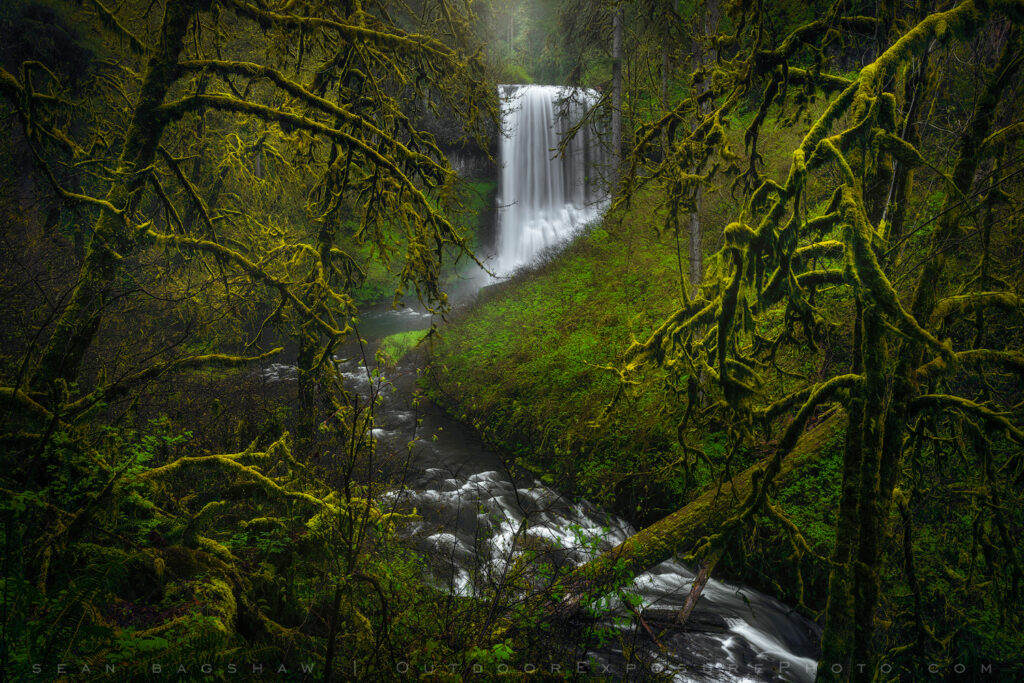
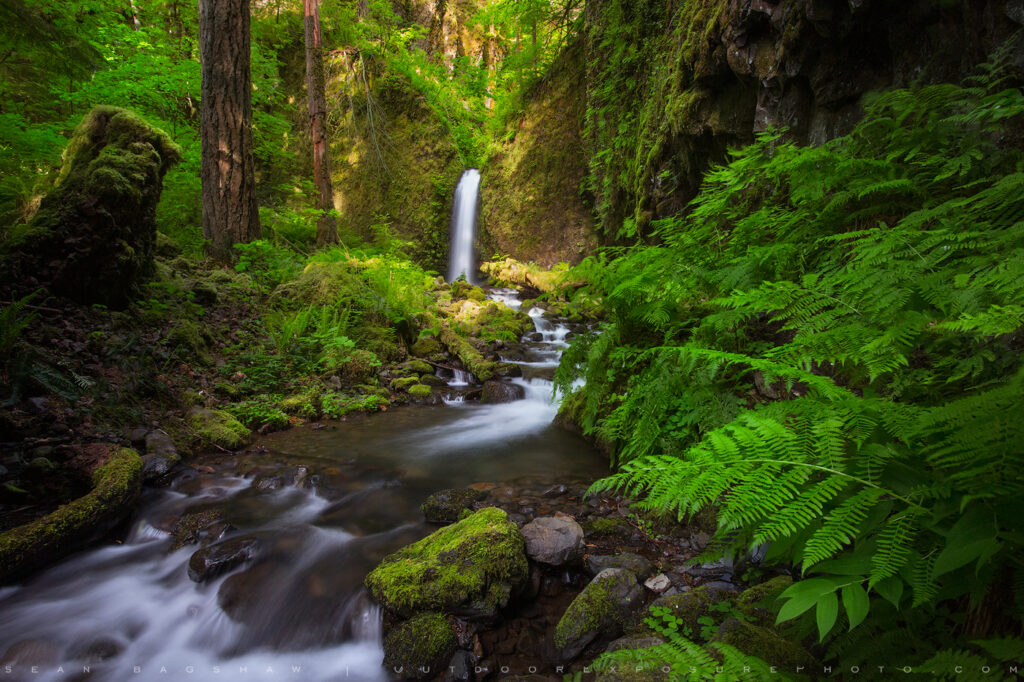
Oregon is home to some of the most astounding waterfalls in the country. In the spring, with good water flow, lush greenery and filtered, overcast light, they offer some great photography opportunities. While waterfalls can be found all around the state, there are a few regions that have many waterfalls in a relatively small area, making it possible to visit a bunch of them in one trip. The three areas that I find particularly visitor friendly are the Columbia River Gorge Wilderness, Silver Creek State Park and the upper North Umpqua River. There are many excellent websites where you can get visitor information and directions to Oregon Waterfalls. Here are a couple I like:

www.waterfallsnorthwest.com/Oregon

www.obbg.org/blog/2021/07/oregon-trail-of-waterfalls-map/

Oregon Waterfalls In The Spring

Photographing waterfalls and rainforest streams can be challenging. The dense forest setting can create a situation of "too much going on" and make it difficult to get unobstructed views and find coherent compositions. Additionally, on a sunny day there is too much contrast between the bright and shadowed areas of the forest making it nearly impossible to balance the light and show detail in all areas of an image. Here are some tips that I have found helpful when photographing waterfalls and dense forest streams.

  • Shoot when the light is soft and balanced. This includes overcast days, mornings, evenings, and canyons deep in shadow.
  • Light rain or mist is your friend. Wet foliage really pops and light fog can add a very mystical dimension to photos.
  • Use a circular polarizer to cut out light scattered off the surface of shiny green plants and the surface of water. The difference this makes is amazing.
  • Shoot on a tripod. Since the best conditions for shooting are lower light conditions, your shutter speeds will necessarily be longer than you can hold steady. Add in a small aperture setting for increased depth of field and a polarizing filter and you could be looking at shutter speeds longer than one second.
  • For the best "smooth water" effects try for a shutter speed between .5 and 1.5 seconds. If your exposure is too long then the water loses all its texture.
  • If shooting digitally, shoot two exposures, one for the water and one for the foliage. When the foliage is properly exposed, the white, foamy areas of water will often be blown out and lacking detail. Shooting two exposures allows you to blend them later in Photoshop to achieve the correct exposure throughout. For my article on how to do this kind of exposure blending click HERE.
  • Look for interesting vantage points. Try angles down close to the water, up on a rock or a rise, across a ravine or from the side.
  • Don't simply shoot the waterfall or stream centered in the middle of the image. Place the waterfall off center and show some of the surroundings to give a sense of place. Look for ways to have curves in the stream lead your eye through the image at an angle. Try to cut out paths, bridges and other signs of people unless you are going for a "humans in nature" shot.
  • Tread carefully and preserve the beauty. Stay on trails in sensitive areas. Don't step on delicate plant life. Avoid muddy and eroding areas. Avoid entering off trail areas that are clearly getting too much use.

Filed Under: Digital Photography Tips, Photography Travel Journal

Funeral Procession Below Cho Oyu

April 9, 2007 by Sean Bagshaw Leave a Comment

Funeral Procession Below Cho Oyu

Funeral Procession

In April and May of 2006 I trekked through four valleys in the Mt. Everest region of Nepal. This region, known as the Solokhumbu, is home to the Sherpa people. Living high in the Himalaya the Sherpa are more closely connected geographically, religiously and ancestrally to the Tibetan people than they are to people living in the lowlands of Nepal.

At over 16,500 feet in elevation Gokyo is one of the farthest outposts of habitation in the Everest Region. Located on a glacial lake directly below the massive south face of Cho Oyu, the world’s eighth highest peak, Gokyo has several lodges that serve trekkers and climbers. The lodges are owned and operated by Sherpa people. While I was there the owner of one of the lodges was killed. He was walking from a lower village in the night and fell off the narrow mountain path. Within hours a contingent of Buddhist Monks were summoned from Khumjung to perform a funeral ceremony. In this photo the monks are leading a procession carrying the body into the mountains to perform the traditional cremation.

Canon EOS 5D

Canon 28-135mm f/3.5-5.6 IS USM lens

1/200 sec @ F/8

More…

Filed Under: Featured Photos, Photography Travel Journal

Photography Travel: Steens Mountain and the Alvord Desert

March 24, 2007 by Sean Bagshaw 1 Comment

Photography Travel: Steens Mountain and the Alvord Desert

Alvord Desert

Last week I took the Eurovan on a road trip to southeast Oregon to do some photography in the Alvord Desert on the east side of Steens Mountain. Talk about some remote country. There are only about four public roads in all of Harney County. From the town of Fields (population less than 20?) on the south end of Steens Mountain to Burns, the county seat, one must drive for two hours on a paved road along the western side of Steens or three hours on a dirt road along the east side of Steens. Either way you pass through only one town not any larger than Fields. One day I drove the entire loop and saw fewer than ten other cars the entire day.

Steens Mountain is actually just one fault block mountain but because it stretches from north to south for so many miles it is often mistaken for an entire range of mountains. From the west it gently slopes up making it look like a large hump in the desert landscape. Then the eastern slope abruptly drops nearly a mile to the Alvord Desert below. Viewed from the east Steens looks very impressive.

The Alvord Desert, named after an old ranch in the area, is an alkali flat that once was a shallow lake. The ground in the flat is, as the name implies, completely level and devoid of any plant life or other features for 100 square miles. It is very similar to the Black Rock Desert where the Burning Man festival is held each year.

steens moutain
Part of the time I focused on taking wide landscape photos of the cracked surface of the Alvord Desert with Steens Mountain as a backdrop. Stormy, dynamic or otherwise dramatic skies and sunset or sunrise light are critical elements in interesting photos here since there is very little else to place in a composition. Unfortunately, with the lowest rainfall totals in Oregon, the skies are often clear. But, when there is moisture in the sky it is often pushed up the west slope forming wave shaped lenticular clouds similar to those on the east side of the Sierra.

There are also several hot springs in the area that are fun to explore and photograph. On the northwest side of Steens is the Malheur National Wildlife Refuge that sees many thousands of migrating water birds each spring and fall. Not far from there is the French Round Barn, one of the last remnants from Pete French’s 19th century cattle empire. During the middle of the day the interior of the barn makes for some interesting photography. Soft light reflects in the open doors gently illuminating the intriguing geometric patterns created by the umbrella shaped roof structure.

round barn

The town of Frenchglen makes a great staging point for driving and hiking trips up the western slope of the Steens. The road is closed by snow in the winter and spring, but in the summer, the views from the top are great. There are several glacier-carved gorges that can be accessed by hiking from the Steens Loop Road.

Filed Under: Photography Travel Journal

Featured Photo: Thamo Nuns

March 16, 2007 by Sean Bagshaw 1 Comment

Featured Photo: Thamo Nuns

Thamo Nuns

In April of 2007 I made a solo trek through four valleys in the Mt. Everest region of Nepal. While part of the country of Nepal, this region is largely populated by the Sherpa people, who practice Tibetan Buddhism and whose ancestors are Tibetan. The Chinese occupation of Tibet over the last half century has made practicing traditional Tibetan Buddhism in Tibet very difficult, restricted and often dangerous. In 1959, in the face of growing danger from the Republic of China, the Dalai Lama fled to Dharamsala, India . As the spiritual and political leader of the Tibetan people, the Dalai Lama has been leading his government in exile and working for peace and the freedom of Tibet ever since. Thousands of Buddhist monks and nuns have also fled Tibet to practice in peace in other parts of the world. Being close to Tibet, both geographically and culturally, the Mt. Everest region is a desirable place for refugee Buddhist monks and nuns to come to. Monasteries are found in many of the villages in the region and carry out their traditional roles as an integral part of Tibetan Buddhist culture.

While trekking through the small village of Thamo in a valley to the southwest of Mt. Everest I came across a partially constructed monastery. The lama in residence was glad to give me a tour. The monastery is being built to house a group of Buddhist nuns who have been worshipping in the village for some years and have outgrown their space. As funds are raised, construction on the new monastery goes forward. The project has been underway for several years and several more years are needed before completion. In the meantime the nuns have been conducting their daily practices in a very small hut that used to be a schoolroom. I was allowed to observe their ceremony and, for a donation to the construction effort, encouraged to take photos. The young nun in the photo is a Tibetan refugee who had first studied in the south of India and had recently moved to the Thamo monastery. During their puja, or ceremony, she never stopped chanting but was very curious about the blond foreigner with the camera. Her inquisitive gaze followed me around the room while many the older nuns continued chanting as if I wasn’t there.

1/50 sec at f/5.6

ISO 1600

Canon 5D

28-135 mm lens

More…

Filed Under: Featured Photos, Photography Travel Journal

Photography Journal: Photographing The Tour Of California

March 8, 2007 by Sean Bagshaw 1 Comment

Photography Journal: Photographing The Tour Of California

Tour of California

Ever since the days of three time Tour de France winner, Greg Lemond, I have been a European cycle racing fan. I also enjoy getting out on my bike as much as I can and even riding in some organized centuries and local races. Now and again I even photograph local road and mountain bike races, finding that the quick thinking and response time required for action photography is a nice break from landscape work. I have a dream about one day following the Tour de France or one of the other grand European pro tours and capturing classic shots of the peleton riding through the Alps or fields of sunflowers.

At the end of February this year I had the opportunity to do the next best thing, and just a few hours drive from my home. Along with some other local cycling enthusiasts I drove down to the San Francisco bay area to follow the first few stages of the Tour of California. In only its second year, the tour attracted over 1.6 million viewers along it’s 650 mile, eight day course which starts in San Francisco and winds its way through wine country and along the coast, ending in Long Beach. It brought together the most distinguished selection of riders to ever compete on US soil. In addition to many strong national teams, nine of the biggest Euro pro tour teams showed up. If you follow the Tour de France, then teams like Discovery, CSC, Rabbobank, Gerolsteiner and Credit Agricole as well as riders like Levi Leipheimer, George Hincapie, Ivan Basso and Paulo Bettini will ring a bell.

I mostly went to be a spectator, but couldn’t resist bringing the camera gear along to try my hand at shooting some world-class cycling action. While I didn’t have access to a motorcycle escort or a media helicopter like the great cycling photographer, Graham Watson, does, I was pleased by how accessible the event was to spectators and photography enthusiasts like myself. In most US professional sporting events, the spectators are confined to stadium seats and may only get within binocular range of the action. But as European cycling enthusiasts are well aware, in road racing the competition is held on public streets and highways where fans can line the course and cheer on their favorites from just inches away.

I traded off using a Canon 20D fitted with a 70-200mm telephoto zoom for distant shots with a Canon 5D fitted with a 16-35mm lens and a camera mounted flash for shooting the riders when they were so close I could touch them. For most shots I tried to maintain a shutter speed of at least 1/800 of a second to freeze the motion. Slower shutter speeds, panning and fill flash can also be used to create some fun motion blur effects to create the sensation of speed.

I followed the first three days of the tour. With a little map work I was able to shoot the race from one pre-scouted location along the course and then drive to the finish city ahead of the riders and capture the action at the end of the stage. It was as fun and exiting as I imagined it would be. Next year I hope to be able to be there for the entire eight days. Then I’ll be ready for a European grand tour. If anyone knows of a motorcyclist with a press pass to the Tour de France and who happens to be looking for a photographer, give him my number.

To check out some of the race photos on my stock site click HERE.
To see a more complete selection of images from the race log on HERE.

Filed Under: Photography Journal, Photography Travel Journal

Photo Travel: Southern Oregon Coast and Washington's Palouse

February 2, 2007 by Sean Bagshaw Leave a Comment

Recently I visited the southern Oregon coast twice and made another trip through central Oregon up to the Palouse region of eastern Washington.

The southern Oregon coast from Brookings up to Reedsport is known as one of the most photogenic coastal regions in the world. With its quaint fishing ports, long sandy beaches, cliffs, rock formations, lighthouses, dunes and a distinct lack of crowds there are endless opportunities to make some great photos. I find the biggest challenge is being there when the nearly ubiquitous fog bank is not.

The Palouse region of eastern Washington covers a large geographical area in Washington, south of Spokane and north of Lewiston. In this landscape of gently rolling hills, farmers grow a good portion of the country’s wheat crops. While interesting photography can be made here all year long the summer months provide the best opportunities. Late summer is the time when the wheat has been harvested and the fields are burned and plowed, creating a patchwork of abstract amber, black and brown shapes and patterns.

To view images you can go to my main site.Â

Filed Under: Photography Journal, Photography Travel Journal

Walking With Giants: Images From Nepal

February 2, 2007 by Sean Bagshaw 2 Comments

For most of my life I have been strongly attracted to mountains. When I was nine years old my dad took me on my first climb of Mt. Thielsen in the Oregon Cascades. Since then I have spent a lot of time looking at them, reading about them, climbing them and photographing them. No mountains have captured my imagination more than the Himalayas where all of the highest peaks in the world are located. For years I have read about the geology, geography, people, culture and exploration of the high Himalayas, particularly the area around Mt. Everest, like I was reading of a fictional land in a fantasy novel. With vicarious anxiety I have experienced the feats of heroic survival and agonizing tragedy that have played out over the last 100 years on peaks reaching so high in to the atmosphere that humans can only survive there for short periods of time. In 1999 I took part in a trek through the Himalayas to Mt. Kailas in Tibet, but our route took us far west of the highest peaks in Nepal and monsoon clouds prevented me from seeing the big summits even from a distance.

           In April and May of this year I finally visited the mountain range of my imagination when I had the opportunity to go on a solo photography expedition in to the heart of the Khumbu region and right up to the base of Mt. Everest itself.

           It turned out that my trip precisely coincided with a particularly difficult time in Nepal’s recent history. I flew to Kathmandu, the capitol of Nepal, smack in the middle of several weeks of strikes and protests aimed at dethroning the King, who in the last few years had steadily been dismantling the democratic government, violating human rights, taking power of the military and generally making things difficult in an already struggling country. He responded to peaceful protests with tear gas, rubber bullets, police beatings and enforced curfews.

           After a couple of days of avoiding burning tires and flying rocks and sympathizing with the troubled citizens of Kathmandu I was able to catch my flight to the mountains to begin my trek. For two weeks I hiked six to twelve hours a day, soaking up the views, meeting the people and taking photographs. I dined with a reincarnate lama, joked with school kids, joined Buddhist nuns conducting their daily prayers, helped an elderly woman fix her rock wall and watched Buddhist monks lead a funeral procession into the mountains for a high altitude cremation.  Strikes and weather kept me from meeting up with my friend Laurie Bagley before she departed for her attempt to climb the north side of Mt. Everest.  But it was exciting to monitor her progress and subsequent success via the Internet knowing that she was just a few miles away on the other side of the hill.

           Significantly humbled by my experiences in the mountains I returned to Kathmandu to find a completely changed Nepal. The King had wisely relinquished most of his power and avoided exile or worse, opening the door for the restoration of the democratic government, a cause for widespread celebrating all over the country. It was great to see people looking happy and optimistic about the future. I hope to see great improvements in Nepal’s quality of life in the months ahead.

           The entire expedition was a mind-expanding journey, one that has even depended my connection with Nepal and the Himalayas. I hope that the photos I brought back capture a slight portion of the experience. You can view a collection of images from my trip HERE…

Filed Under: Adventure Journal, Photography Travel Journal

Denali Expedition: Cheese Wizardry

February 2, 2007 by Sean Bagshaw Leave a Comment

On June 18, 2005 my climbing partner, Brock Rowley, and I will be flying to Alaska for a climbing expedition on North America’s highest mountain, Denali. At 20,320 feet above sea level, Denali is also the highest mountain close to the Artic Circle and is infamous for big glaciers, seriously cold temperatures and nasty weather. Brock and I were members of a 1998 six-man expedition to Denali and reached the summit on that trip. This time around it is just the two of us. We have named our expedition Cheese Wizardry in anticipation of the creative ways we will fit cheese in to our diet during the three-week climb. It also alludes to our climbing abilities (or lack there of). We will attempt a route called the West Rib, but if it isn’t in good condition or if we are too chicken the plan is to shift over to the West Buttress Route, the most popular route on the mountain and the route we took in 1998. There is a chance that we won’t even be able to reach the mountain at all. Low snow pack and warm spring temperatures may close the Kahiltna Glacier to ski plane landing early this season. Without air transportation to the glacier reaching Denali is extremely difficult. If the climbing season ends early this year, plan B is to explore and climb in an area near Denali called the Ruth Gorge. “The Ruth” is an amazing alpine environment with 4,000-foot granite walls. It is often referred to as Yosemite Valley with glaciers. Either way, a fantastic adventure is in the making with many opportunities for stunning photography. Stay tuned for the story and photos later this summer.

Filed Under: Adventure Journal, Photography Travel Journal

Winter Photo Visit To Crater Lake National Park

January 29, 2007 by Sean Bagshaw 1 Comment

Winter Photo Visit To Crater Lake National Park

I always find it difficult to get out and photograph during the winter. The days are short and cold. The sky is often an unappealing gray and the weather is hard to predict. However, I find that when I do go out I’m usually pleased with what I find.

Recently I loaded up my VW Eurovan camper and headed to Crater Lake National Park which is about 80 miles from my home. Crater Lake always makes for a great outdoor experience, but in the winter it is especially stunning and sees very few visitors. Sometimes I like to make a full backcountry adventure and ski or snowshoe around the rim of the lake. On two occasions I have attempted to complete the entire 35-mile circumnavigation. The first time ended up being a seven-day epic in a multi-day blizzard. The second time I took a different approach and skied the entire distance in a single day in good weather. On this most recent and less ambitious trip I planned to camp overnight in my van and photograph the sunset and sunrise and do a little snowshoeing not far from the parking area.

Snowshoeing

The rim of Crater Lake is over 7,000 feet in elevation in the Cascade mountain range and is subject to severe winter conditions. Driving can be hazardous and the roads are often closed by snow. It is not unusual for there to be a snow pack of 10 or 15 feet. During stormy weather the lake is often hidden in a cap of clouds. There are also many good weather days each winter, so it is worth trying to time a visit with a clear spell.

I like to shoot at dusk and dawn. Even during good weather the temperatures at these times are usually below freezing and there is often a stiff breeze. I wear normal winter layers, warm boots and a hat. My three most critical layers are my gaiters, down jacket and Windstopper gloves. The gaiters keep snow out of my boots while wandering around in the snow. My down jacket provides good insulation for my core even while I stand still behind my tripod for long stretches. My windstopper gloves are made of thin fleece and have enough dexterity to operate my camera. The Windstopper layer blocks the wind and makes the gloves very warm for how thin they are. I also bring my snowshoes so I can venture off a bit into the untracked snow.

Crater Lake

During this visit I was treated to a fantastic sunset and interesting ice patterns on the partially frozen surface of the lake. Before dawn I hiked out to a point overlooking Wizard Island and Lao Rock and photographed the changing light as the sun came up. To view some images from this trip click HERE.

Filed Under: Photography Equipment, Photography Journal, Photography Travel Journal

Featured Photo: Corkscrew In Antelope Canyon

January 23, 2007 by Sean Bagshaw 2 Comments

Featured Photo: Corkscrew In Antelope Canyon

Antelope Canyon

Corkscrew In Antelope Canyon

Antelope Canyon is most likely Arizona’s most visited slot canyon. It is especially popular with photographers for obvious reasons. The upper section of Antelope Canyon is known as the “Corkscrew”. This name applies to the entire section of the canyon, but I think this particular view characterizes it best. Using long exposures and cooling filters, the color of the blue sky reflecting from the red sandstone
creates brilliant purple tones.

38 Seconds at f/22

Canon EOS 5D

EF 28-135mm f/3.5-5.6 IS USM lens

Gitzo Mountaineer Carbon Tripod

More…

Filed Under: Featured Photos, Photography Journal, Photography Travel Journal

Featured Photo: Reflecting Pool In The Wave

January 19, 2007 by Sean Bagshaw Leave a Comment

Featured Photo: Reflecting Pool In The Wave

Reflecting Pool In The Wave

Reflecting Pool In The Wave

Eroded sandstone formation known as “The Wave”

North section of the Coyote Buttes, Arizona

.6 sec at f/29

Canon EOS 5D

EF28-135mm f/3.5-5.6 IS USM lens

Circular Poloarizer

Gitzo Mountaineer Carbon Tripod

More…

Filed Under: Featured Photos, Photography Travel Journal

Featured Photo: Sunrays Radiating From Behind Mt. Everest

January 15, 2007 by Sean Bagshaw Leave a Comment

Featured Photo: Sunrays Radiating From Behind Mt. Everest
Sunrays Radiating From Behind Mt. Everest

Sunrays Radiating From Behind Mt. Everest

Taken at sunrise atop 17.500 foot high Gokyo Ri, Nepal Himalayas.

1/50 s at f/6.3, ISO 100

Fill Flash

Canon EOS 5D

EF 28-135mm f/3.5-5.6 IS USM lens

Gitzo Mountaineer carbon tripod

More…

Filed Under: Featured Photos, Photography Journal, Photography Travel Journal

Mt. Everest: One Step At A Time

January 5, 2007 by Sean Bagshaw 1 Comment

Mt. Everest:  One Step At A Time

Experience a Mt. Everest Climb With Shasta Local Laurie Bagley

Climbers
photo: Scott Woolums

Location: Rogue Rock Gym CLICK HERE FOR DIRECTIONS

Date: Saturday, January 27, 2007

Time: Show starts at 7:00 PM

Tickets: $8 in advance, $9 at the door (kids 13 and under half price, 5 and under free)

Advanced tickets available at The Rogue Rock Gym, The Ashland Outdoor Store, Flywheel Bicycle Solutions and McKenzie Outfitters.

In May of 2006, Mt. Shasta climber Laurie Bagley became only the 19th US woman to summit the world’s highest peak. 2006 was the second most deadly climbing season in Mt. Everest history and became the subject of a documentary series that has been showing on the Discovery Channel. Laurie and her climbing group managed to be the only team on the north side of the mountain last year that did not sustain fatalities, injuries or frostbite.

Laurie is a careful and humble climber whose physical strength is only matched by her inner strength and concern for others. The story of her inspiring personal challenge on Mt. Everest and her motivation to attempt the climb to raise money and awareness for the poorest children of India should not be missed.

You are invited to attend this once in a lifetime evening with Laurie as she shares her powerful story in words and pictures with a media show produced by Outdoor Exposure Photography. We hope to see you there.

Filed Under: Adventure Journal, Past Events, Photography Travel Journal

Antelope Canyon Is Overcrowded But Still Worth Photographing

December 27, 2006 by Sean Bagshaw Leave a Comment

Antelope Canyon Is Overcrowded But Still Worth Photographing

For years, photographs taken in the narrow sandstone slot canyons of the American southwest have captivated me. The curving, wave-like shapes, improbably red sandstone walls and magical reflected orange and yellow light all come together to allow a photographer to create pictures that suspend reality. There are countless slot canyons to be found throughout the desert regions of Utah, Arizona and New Mexico, and there are no doubt many more that have yet to be discovered. Most slot canyons are known only to desert explorers, and are usually hard to find, difficult to get to and require rope and climbing skills to be explored. On a trip to Arches National Park a few years back I read a guidebook that detailed how to get to a couple of the better-known slots in central Utah. I quickly realized that good maps, a serious off-road vehicle, supplies for desert survival, climbing equipment and several days of time would be necessary if I wanted to visit them. However, I also knew that one particular slot was at least somewhat accessible to the general public. I knew this because I had seen photos taken by photographers who I knew to be considerably less accomplished backcountry travelers than myself. I knew the name of the slot was Antelope Canyon but I didn’t know its location and failed to locate it on that particular trip.

Antelope Canyon 1

After that trip I continued to see photos of Antelope Canyon. Each photo is so captivating and improbable I began to wonder if I had what it took to capture a piece of the magic or if special techniques and perfect timing on a few rare days a year were required. Earlier this year I was planning to make another trip to the four corner states with my friend, Greg, and decided that I would do some advance research to find out more about Antelope Canyon.

Searches into my photo travel books and on the Internet revealed Antelope Canyon to be even more accessible and well known than I had thought. Located just a few miles east of Page, Arizona, it is accessed from a large parking area right off of Highway 98. It also turns out that, while not as well known in the Northwest as the national parks are, Antelope Canyon is enough of a destination that it ends up on the itinerary of many visitors along with the Grand Canyon, Monument Valley and Zion. The saturation of photos of the canyon that have been published in recent years has made it trendy enough to even attract the attention of celebrities and movie productions. Most comments from other photographers on the Web indicated that trying to shoot there these days should be avoided at all cost. The general attitude is that Antelope Canyon has become so crowded that photographing it requires monk like patience and determination to deal with hundreds of people crammed into a ten foot wide crack all jostling, pushing and walking in front of your camera.

Antelope Canyon 2

Antelope canyon has an upper and a lower section, each accessed from opposite sides of the highway. The upper canyon is about three miles from the road and is easily entered on foot by walking in through its outlet in the cliff wall. At one time you could reach the upper canyon on your own by driving your off road vehicle or hiking in from the road, but now the Navajo Nation, which the canyon is part of, strictly limits visitors to taking one and a half hour guided tours on large trucks that leave from the parking area or from tour companies in Page. By the time you pay for parking and the tour the tab comes to about $21. The lower canyon, which was closed due to flooding during my visit, is closer to the road, but apparently requires some scrambling and rope work to access. Slot canyons are formed by wind and water eroding narrow channels into soft sedimentary rock. In some places slots are only a few feet wide and can be hundreds of feet deep. The wavelike shapes of their walls appear to flow like the water that created them.

Our initial instinct was to take the advice I had read online and blow right past Antelope without a second thought, but then we ended up staying in the Page area with an extra day in the schedule. In the end, our trepidation of being trapped in a tight crowded space, hurried along by disgruntled Navajo guides was overridden by the lure of taking magical photos. We paid the money and climbed in the back of an old Chevy 4×4 with oversized tires with about ten or twelve other folks. In a line of three or four trucks we drove up a dry riverbed into the desert. Arriving ten minutes later at the canyon entrance we took deep breaths and were prepared to leave our cameras in our packs when we saw that there were already eight or ten other tour trucks parked there.

The young Navajo woman who was our guide, and who turned out to be very good humored, knowledgeable and photographer friendly, said that for the first fifteen minutes she would lead us through the quarter mile length of the canyon pointing out interesting features and then turn us loose for 45 minutes to explore and photograph. She also informed us that it was possible to pay an additional $10 to stay for another hour and return on a different truck.

Entering the canyon I was immediately transported back to all the photos I had ever seen. Walking along staring up 120 feet into the narrow reaches of the canyon walls I was completely absorbed. It was just as amazing in real life as in photos. Dutifully I followed along with the group even though I was tempted to ditch them for fear of wasting precious shooting time.

Antelope Canyon 3

The next 45 minutes flashed by as I rapidly moved from one location to another, setting up my tripod, composing and capturing shot after shot. A couple of other groups passed by from time to time, but I think most people hiked up to the end of the canyon and back and then waited outside for the trucks to leave. Rarely did I have a problem with people getting in my shot or bumping my tripod. Most of the shots are composed up high on the canyon walls and over the tops of people’s heads. More than once I was completely by myself for up to ten minutes at a time. When the hour was up we gladly paid the additional $10 so we could stay for another hour. During the second hour a group would come through from time to time, but in between would be long periods in which the only other people I encountered were fellow photographers crouching in the shadows.

The most popular and busy time to photograph Antelope Canyon is during June, around the solstice, when the sun passes most directly overhead. Near midday, shafts of direct light penetrate all the way down to the floor of the canyon. Many of the photos you see feature these bright shafts piercing the dim light, turning whatever they strike bright white. We were there in early October and I liked that I wasn’t worried about staking out a spot in order to be ready when a shaft of light appeared. Instead it was nice to be free to explore the entire canyon and focus on more subtle compositions and lighting. The most important tip for getting good photos in the canyon is to be there on a clear, sunny day an hour or two before or after noon when sunlight is striking the upper walls at an angle that allows it to reflect back and forth deep into the canyon. I found that right at noon direct light penetrated far enough in that it was hard to keep it from causing lens flare or blowing out sections of the canyon walls. Another good tip is to try to set up your camera in the most deeply shadowed areas to prevent flare-causing light from entering the lens. I shot on a tripod with a small aperture (f/18 or more) and long shutter speeds at an ISO of 100. My exposures were several seconds long, so I also shot with a cable release and used the mirror lock up function to prevent vibrations. I exposed my shots so that the brightest highlight areas were on the edge of overexposure making them appear to glow yellow/white-hot. In some areas the angle of the rock would actually reflect some of the blue sky itself, creating neon blue and purple tones. If I could do it again I would use my long lens more to zoom in on some of the brighter areas of rock near the top of the canyon.

In what seemed like moments the second hour was up and we emerged, squinting, into the bright desert sun. My head buzzed with adrenaline after focusing so hard to interpret the constantly changing shapes and light during the previous two hours. I don’t know if we were lucky to get the shots we did or if it just felt that way after having such low expectations, but in the end we were very glad that we decided to go for it. Antelope Canyon is too well known to offer the quiet kind of solitary experience that it once did, but it is still a mind bending natural formation that brings together all the elements of color, shape, texture and light needed for one of a kind photos. Despite the crowds I would recommend it to photographers, just as long as you don’t mind taking the same one of a kind photos as everyone else.

Filed Under: Photography Travel Journal

Photo Travel: The Colonial Mining Town of Guanajuato, Mexico

September 13, 2006 by Sean Bagshaw 2 Comments

Photo Travel: The Colonial Mining Town of Guanajuato, Mexico

“Guanajuato is beautiful, but one can’t explain in words what makes it truly special,” exclaimed Senora Villaneueva, our kind, elderly home stay host during one of her grand afternoon meals. The Senora was born in the Mexican hill town and has lived there her entire life. “Si,” we chimed in united agreement!

Guanajuato, Mexico at night

My wife, Jennifer, had spent the previous two weeks living in the Spanish colonial mining town taking language courses at the Academia Falcon. Intrigued by visions of the sharp geometry and bright colors to be found in the brick and stucco architecture I flew down to meet her and spend a week photographing the sites.

Guanajuato was declared a UNESCO World Heritage Site in 1988 and is also the sister city of Ashland, Oregon, my hometown. The two towns have many things in common, such as renowned theater festivals, universities and thriving art cultures, not to mention both being situated in picturesque mountain valleys.

From a photographer’s perspective, Guanajuato is an endless canvass. The population is very compact and the streets are a maze of narrow alleys (callejones), cobbled streets, curving stairways and fountain squares. The rectangular houses follow the contours of the hills and are stacked atop one another in an intricate, interlocking puzzle. Brightly painted stucco of every color creates a patchwork that spreads across the landscape.

Orange House in Guanajuato, Mexico

Located about 200 miles north of Mexico City, Guanajuato once sat upon the banks of a river. As the city grew the river became a channel flowing between the walls of buildings. Over time, many of the buildings were built out over the river until they met with structures on the opposite side, enclosing sections of the river in tunnels. The river would frequently flood the town until the 1960s when a dam was built and the river was diverted. The now dry channels and tunnels have been paved and converted for use as the main thoroughfares for vehicle traffic, leaving many of the narrow cobblestone streets open for pedestrians to wander at leisure.

Narrow Alley In Guanajuato, Mexico

Aside from the photography potential, the city is dense with enough old churches, theaters, museums, art galleries, restaurants and monuments to fill weeks of sight seeing. Every evening locals and tourists fill the streets around the town center to shop, eat, attend theater performances, listen to a wide variety of live street music or hang out in the taverns and dance clubs. In keeping with Latin culture, every night in Guanajuato feels like a regular fiesta.

I spent much of my time photographing doors, alleys and buildings. I also turned my camera toward some of the better-known landmarks, such as the Teatro Juarez, the University of Guanajuato, El Pipila and the Basilica Nuestra Senora.

To view my photos of Guanajuato please go HERE.

Filed Under: Photography Travel Journal

« Previous Page

© 2026 · Sean Bagshaw Outdoor Exposure Photography