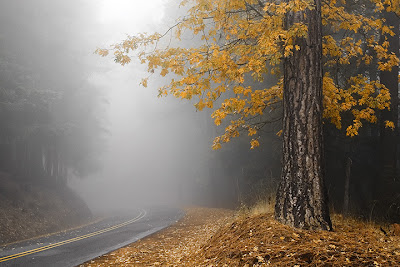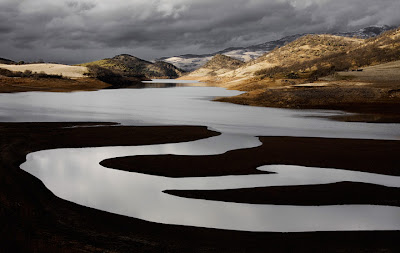
John Wimberley is an important photographer, teacher and friend. When His wife Teri was diagnosed with Multiple Myeloma we were all shocked and saddened by the news. Several fine art photographers have created portfolios of work to be given away in a benefit raffle. Click the image below for more information. To purchase tickets contact Robert Brummitt at 503-614-0161 or email at robert8x10@comcast.net.
Featured Photographer: Al Magnus
My photography has many sources of inspiration, and not all of them are standard nature photographers. I like to bring an element of fantasy to my images, but very few photographers do it as well as Al Magnus. His photo illustrations are the product of collecting images of various elements, sometime over the course of years, and then painstakingly merging them to create wondrous photo-illustrations. You can see more of Al Magnus’ work at www.almagnus.com
Photo Tip: Blurry Trees
Much of my photography is of the greater landscape and I’m often trying to present sweeping vistas with sharp detail. However, I also like to photograph more intimate scenes and abstracts. One of my favorite abstract techniques is motion blur. This can be achieved a few different ways and is a particularly good technique for emphasizing leading lines in a photo while smoothing out distracting elements. The final result can often look more like a painting than a photograph.
I really like to use motion blur with trees that have staight trunks. The technique is more an art than a science, so a lot of experimentation and throw away images are required to get something that I like. I start by setting a relatively slow shutter speed and making a vertical pan (movement) with my camera. I have found that shutter speeds between 1/4 of a second and 1/20 of a second work best. I move the camera up or down, in as straight a line as possible and depress the shutter release as the camera is moving. At slower shutter speeds I pan slower and at faster shutter speeds I pan faster. It is hard to know exactly what will be in the frame so I repeat the process over and over so that I will have many images to select from. Panning the camera while it is on a tripod can help keep the motion steady and smooth, but also limits flexibility.
Physically panning the camera is often all I need to do to achieve the abstract look I’m going for. Other times I selectively add more blur by using the Motion Blur filter in Photoshop (Filter>Blur>Motion Blur). To do this I’ll create a duplicate layer of the background image and blur the duplicate. Then I’ll add a layer mask to the blurred layer and paint with a black brush on the mask to bring through any detail from the original image that I want to keep. This digital blurring technique can also be applied to images that were taken in focus without panning the camera. Digital blurring often takes just as much trial and error as panning the camera.
Several of my favorite photographers have used these techniques to create some wonderful abstract images, including Jesse Spear, Eddie Soloway and William Niel.
Featured Photographer: David Lorenz Winston
David Lorenz Winston is a highly talented, respected and well known photographer whose career has spanned 30 years. I am fortunate to live in the same town and call him a friend. In the past couple of years he has greatly inspired and influenced my work. I highly recommend visiting his site at www.davidlorenzwinston.com and his BLOG. Below he explains the importance of relationship in photography.

For me, photography is about relationship. At times the relationship is between me and my subject(s), but more often its between subjects, animate or inanimate within the picture frame. To emphasize relationship I like to juxtapose, contrast, uncover humor and create mystery. Often these elements weave together. Sometimes relationship is about alienation, a sense of isolation in relation to self or surroundings. Ultimately, my photographs reveal a lot more about how I perceive the world than the subjects they depict.

Without relationship a photograph remains in a sense, two dimensional. With relationship there is always the possibility of transformation, creating more than the sum of the parts.
Nepal Through The Lens Of David Price
David Price is a photographer from the UK who I have struck up a long distance friendship with. He has a great talent for photographing people. He was recently on a photo assignment in Nepal, a place I am very fond of. He captured beautiful images of the Nepali people in a way that I wish I could. What follows are images and thoughts from his adventure. You can see all his images at his site www.davidprice.uk.com.
Back in England I sit in my apartment several thousand miles from Kathmandu my thoughts firmly with the people of Nepal. Although now great distance separates my new friends and I, editing my images I have just spoken by telephone with film producer Sanu Thapa and the distance between us seems not so great.
Commissioned to photograph a football tournament and school opening in Kavre south west of Kathmandu. My customer UAP ltd gave me this opportunity and I did not think twice about accepting. The event run by charity DCWC Nepal included a volunteer medical team who treated two thousand patients in five days……..AMAZING ! I extended my trip to Nepal beyond my work in the village; Kathmandu was my home for 18 nights with my guides Komal Lama, Vijaya Thapa and film producer Sanu Thapa.
My memories of Nepal are not of the cues for fuel or the twice-weekly power cuts and the candles in my room, my mind cannot forget the people of Kavre and also a wider Nepal. Speaking only a few words of Nepalese I found a strong connection was quickly formed with the people even though our meeting may have only lasted a few moments. I find the strength of the people incredible, talking with Dr Ramu Sharma, he told me of a patient he treated in the village a lady who had given birth nineteen times with 13 children surviving. To bring up this huge family with no electricity or running water just seems beyond belief. This storey highlights the difference in our two worlds; mine being a combatable life in England with more or less everything a man could want and the harsh reality of life in Nepal. My resounding memory is of its people’s gift of friendship and their wonderfully happy smiles. At times I was overwhelmed by the number of people who wanted to be photographed, and on occasions I put away my camera just for a short break.
Kavre village lacked many things I take for granted in England such as a hot shower however I embraced my time there and will never forget it. With no mobile phone or Internet I immersed myself in work pausing briefly to eat or wash in the river an amazing experience. I did not care about communication with the outside world, it was just my work and the people and what more could a passionate photographer ask for. As I left the village after five days tears in my eyes, looking back from the steep path climbing from the valley bottom my thoughts were not of leaving this amazing place but of my compulsion to return.
Crazy Kathmandu. Back in Kathmandu my work at times was difficult I found the speed at which things happened frustrating. I commissioned a short film that was produced over three days by director Sanu Thapa. I am overjoyed with his work and you can watch the film here LINK TO FILM PAGE. Often I organised my own work, waiting to long for other people to do it for me, it’s a very different world in Nepal a lot slower pace than in England. If things happen at all seemed to have little importance and I lost count of the times I was told “tomorrow”. I take my work very seriously and will let little come between my subject and me. My guides on reflection were so good to me they all tried to accommodate my wishes and I visited all but one of there homes, something I feel very privileged to have done. I forged a strong bond with all three guides a process that started on my second night in Kavre when I sat talking with Komal Lama until the early hours. In Komal I see a very good man! Highlights of my work in Kathmandu were photographing models in traditional Nepalese costume and meeting and photographing Shabhu Tamang who submitted Everest age 17 in 1973. I was thrilled to meet for the first time a man who had stood on top of the world. I also built a good relationship with the Sadhu men of Durbury Square producing several memorable images.
As I sit editing the images created in Nepal my realization is that without the people I would have no photographs. It is the people of Nepal that made my trip so memorable. I have a strong desire to return and meet my new friends again to shake their hands and to see how they have changed. My next visit to the country is not in question my only concern is of timing.Thank you to my guides Vijaya, Comal, Sanu and the people of Nepal