
Sean Bagshaw Outdoor Exposure Photography

Images from the edge

See all image results...

Search Criteria
Exact matches only
Search in title
Search in content
Content Type
Select all
Search Posts
Search Prints & Stock Photos
Search Events
Search Pages
  • About
    • Sean’s Biography
    • A Look Through My Lens
    • Social Media
    • Alliances
    • Sign Up For My Newsletter
    • Website Tour
    • Interviews And Podcasts
    • CV
  • Tutorials & TK Photoshop Plugins
  • Learn Nature Photography
  • Videos From My YouTube Channel
  • Signed Prints
    • Favorites Of 2023
    • OREGON
    • CANYONS AND RIVERS
    • CITYSCAPES
    • COASTAL
    • DESERTS AND PRAIRIES
    • FLOWERS AND PLANTS
    • FORESTS AND TREES
    • MOUNTAINS AND LAKES
    • NATIONAL PARKS
    • STREAMS AND WATERFALLS
  • PRINT OPTIONS
  • Stock Photography
    • OREGON
    • NORTH AMERICA
    • THE REST OF THE WORLD
    • AGRICULTURE AND VINEYARD
    • BUILT BY PEOPLE
    • NATURAL BEAUTY
    • OUTDOOR AND ADVENTURE
  • Books & Calendars
    • Calendars
    • Washington Evergreen
    • Oregon, My Oregon
    • Photographing Through The Seasons
  • Workshops
  • Events
  • Photography Blog
  • Contact
  •  

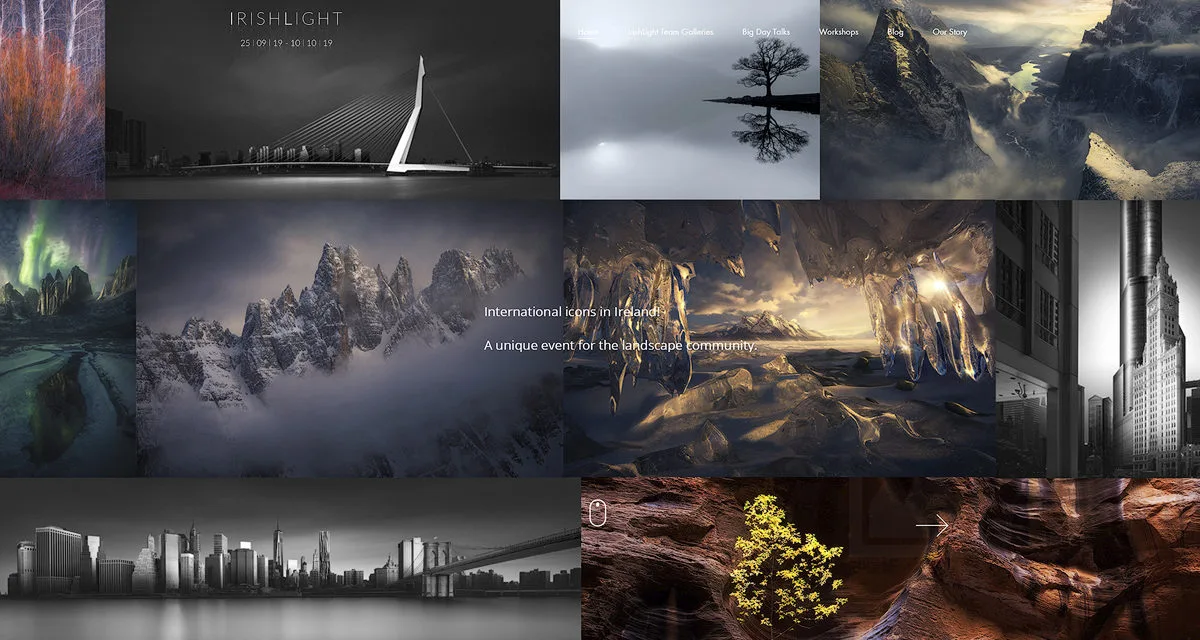
Sean speaks at IrishLight Landscape Photography Festival in Dublin, Ireland

April 4, 2019 by Sean Bagshaw

Registration and more information

“IRISHLIGHT is a landscape photography festival with a range of events that we hope will help to inspire and educate the landscape community in Ireland and abroad.

The festival is run by Peter Gordon and Jelena Derk as a forum to pull the best professional Irish based landscape photographers together, bring international photographers to Ireland while also mobilizing the amazing enthusiast talent that exists both here and abroad.”

Presenters this year include Marc Adamus, Joel Tjintjelaar and Paul Sanders.

Sean will be speaking on October 6th at The Royal Marine Hotel in  Dun Laoghaire, Dublin, Ireland.


Tagged With: digital photography, digital workflow, fine art photography, landscape photography, light, nature photography, outdoor photography, photography technique, sean bagshaw photography

Chasing Light – A Presentation at The Ashland Outdoor Store

November 13, 2013 by Sean Bagshaw Leave a Comment

Chasing Light – A Presentation at The Ashland Outdoor Store

Join me on Thursday, November 21 at the Ashland Outdoor Store for an evening of images and stories. I will be sharing the vision and spirit of exploration that guides my search for rare light and dramatic landscapes as well as a glimpse into the techniques I use to create my photographs. The presentation begins at 7:00 PM and is free and open to the public. The Ashland Outdoor Store is located at 37 Third Street, Ashland, Oregon.
Chasing Light [1.0]

Filed Under: Past Events Tagged With: landscape photography, light, nature photography, Photography Presentation

Doors And Windows of Guanajuato

January 21, 2010 by Sean Bagshaw 6 Comments

Doors And Windows of Guanajuato

One of my favorite photography projects in Guanajuato is exploring the callejons (narrow alleys) in search of interesting doors and windows. Many of the home owners in this town take great pride in their houses. Bright colors are popular and particular attention is paid to doors and windows. While some doors are kept carefully, other doors are neglected and have an authentic patina of time.

With a rumored two thousand callejons in the city, all lined with buildings, there is no lack of doors and windows. Every door is different. Some are pristine, with carved and crafted hardwood and hand forged metal parts. Others are weathered and full of character. Some are precariously set in crumbling stone and brick and covered with graffiti. Each one tells its own story.

As a photographer, I love the way light is reflected at different times of day in Guanajuato. The alleys are narrow enough that they transmit light in a way similar to a desert slot canyon. Direct sun striking the upper reaches of a deep alley can bounce back and forth off of the buildings, projecting a soft, radiant light deep into the shadows. A fully lit alley wall can also reflect a very strong glow onto the adjacent wall or around corners.

The light is constantly changing, so part of my challenge is to find doors and windows that have special character and then return to photograph them when they are illuminated by particularly intriguing lighting conditions.

These are just a few of the door and window photos I have taken on this visit so far. I also took a bunch last time I was here and I’ll probably photograph some more before I leave. I’m not sure what I’m going to do with all the door photos. Photographing them is mostly a compulsion. I suppose I’ll publish some of the best ones on greeting cards. I have also had requests for a “Doors of Guanajuato” poster, which I think is a pretty good idea.

If you enjoyed this photo essay consider sharing it on your social media network of choice using the handy links below.

Filed Under: Photography Journal Tagged With: fine art photography, Guanajuato, light, Mexico, photography technique, travel photography

Guanajuato City Scenes

January 17, 2010 by Sean Bagshaw Leave a Comment

Guanajuato City Scenes

An important element of photographing while traveling in other countries is the ability to take what comes. Last Saturday I carefully penciled out my shooting schedule for the next three weeks in and around Guanajuato, Mexico. That night I came down with some sort of stomach ailment that confined me to bed until Wednesday. While feeling much better a week later, I’m still regaining my strength and can’t wander too far from a bathroom. As a result I didn’t get nearly as much photography done as I hoped and now I need to adjust my plans. But that’s OK. There are some things you can’t control when in another country.

Pink House on Calle Tecalote

As my condition improved through the week I went out to take photos as I was able. The weather has remained mostly cloudy and a bit drab, but there have been moments of the brilliant light that that Guanajuato is known for.

The unusually cold and wet conditions reminded me of some tips for making the best of urban photography at times when the weather is less than ideal. First, since cities provide their own light, twilight and night photography are opportunities for great light even when the weather is poor. There are two periods each day, around sunrise and sunset, when cities come alive with their own light, even on overcast days. During twilight a dull gray sky will appear blue while city lights glow in a variety of colors. A second tip is to be prepared to move quickly during weather breaks. I was able to quickly jump into action a couple of times when sun broke through the clouds for brief periods. The photo ops didn’t last long, but the light was particularly dramatic.

Brief Sunbreak at Sunset

The images in this post are of city vistas and of some of the notable landmarks around Gunajuato. I took them either in twilight or night time lighting conditions, or during a few breaks in the cloudy weather. I hope you enjoy.

Templo San Diego
Templo San Diego
Basílica de Nuestra Señora de Guanajuato
Teatro Juárez
Teatro Juárez
Iglesia de San Francisco
Stormy Sunrsie
Stormy Sunrise

Filed Under: Photography Journal Tagged With: Guanajuato, light, night photography, photography tip, tips, travel photography

Longer Exposures For More Saturation and Luminosity

October 6, 2008 by Sean Bagshaw 1 Comment

Longer Exposures For More Saturation and Luminosity

Â

In situations involving low levels of light it can often be beneficial to obtain a longer exposure to allow the sensor/film more time to absorb color and glow. There can be a lot of color and light bouncing off clouds and hills that our eyes can’t pick up. Cameras are able to “see” into low light scenes by leaving the shutter open and collecting more light. If I really want to pull as much light and color from a scene as possible I’ll often use a neutral density filter (ND) along with my usual filter stack (polarizer and graduated neutral density when needed) and also set the ISO on my camera down to 50 in order to extend what was already going to be a long shutter speed.

A neutral density filter is a neutral gray piece of glass or plastic that is placed in front of the lens. Since it is neutral it doesn’t change the color of the image or do any other special effects. All it does is reduce the amount of light that can pass through the lens to the image sensor or film (kind of like wearing color neutral sunglasses). By reducing the amount of light coming in, the exposure time needs to be longer to get a properly exposed image. One effect of longer exposure times is the blurring of anything moving within the image (water, clouds, wind blown trees, etc.). Another affect is that if there is low level colored light washing over the scene it will saturate in the image over time. I use Singh-Ray neutral density filters because they are some of the most color neutral filters available and give excellent results. I also use Singh-Ray Graduated Neutral Density (GND) filters. GND filters are neutral gray at the top and fade to clear near the middle. They are used to hold back the light in one part of an image (like a bright sky) in order to balance the light across the scene.

The two photos above were taken one right after the other, the first at 6 sec @ f/20, ISO 100 with a 3 stop GND for the sky. The second was taken at 30 sec @ f/20, ISO 50 with a 3 stop GND and a 3 stop ND. Quite a difference 24 seconds of shutter time can make.

Filed Under: Digital Photography Tips, Photography Journal Tagged With: digital photography, exposure, filters, graduated neutral density, help, light, long exposure, neutral density filters, photography, pointers, saturation, singh-ray filters, techniques, tip, tips, tutorial

Photo Tip: The Difference Light Makes

August 18, 2008 by Sean Bagshaw Leave a Comment

Photo Tip: The Difference Light Makes

Photography is all about light. Without it, no photo. However it goes far beyond that. The type, direction, color, amount and quality of light, as well as the photographer’s ability to see and manage the light, are serious contributors to the success of a photo. The ability to see, feel and anticipate light as well as know how the camera will capture light are skills that take a long time to acquire. Some light is right for some scenes but completely wrong for others. The best way to learn what works and what doesn’t is to get out and shoot in all lighting conditions and stick around to shoot the same subject as light is changing, all the while making special note of how the light looks to the eye.

Sometimes it is difficult to know by eye just how much impact the light going to have on a photograph. The best way to realize the impact of light is to compare photos of the same subject matter under different lighting. The following two photographs really illustrate the value of such an exercise. These photos were taken less than two minutes apart, one before the sun rose over the horizon and the second, just after. There are times when the soft glowing light that comes just before sunrise gives perfect even, luminescent lighting to a scene, picking up subtle details and working its way into the deepest shadows. However, in this case, there isn’t enough separation of elements or correctly angled surfaces in the scene. The even lighting causes the tree, rocks and mountains to appear muddy and not well defined and the sky washes out to an unattractive white.

tree 1
tree 2

What a difference a little time makes. In the second image, just a few seconds later, bright, warm, low angle direct sunlight has broken over the horizon, side lighting the scene. It brings out color and adds needed definition and depth to the image, all things the eye looks for. In addition, the direct sunlight coming in at 90 degrees to the camera lens allow for the best polarization effect from a circular polarizer, enhancing the color of the tree and rocks and helping to darken the blue sky.

The composition itself isn’t particularly interesting, but the addition of the right light can make a surprising difference in how appealing it is to the eye. This is a great example of a particular type of light enhancing an image. Unfortunately, it isn’t a perfect formula for success and you shouldn’t try to achieve the same type of lighting for every image you take. In another situation you might find that the pre sunrise light actually creates the most appealing image.

It all comes down to time spent shooting in all lighting conditions, becoming more familiar with what works and increasing your chances of being there when the light is right.

Filed Under: Digital Photography Tips, Photography Journal Tagged With: landscape photography, light, outdoor photography, photography, photography technique

© 2026 · Sean Bagshaw Outdoor Exposure Photography