Sean Bagshaw Outdoor Exposure Photography

Images from the edge

See all image results...

Search Criteria
Exact matches only
Search in title
Search in content
Content Type
Select all
Search Posts
Search Prints & Stock Photos
Search Events
Search Pages
  • About
    • Sean’s Biography
    • A Look Through My Lens
    • Social Media
    • Alliances
    • Sign Up For My Newsletter
    • Website Tour
    • Interviews And Podcasts
    • CV
  • Tutorials & TK Photoshop Plugins
  • Learn Nature Photography
  • Videos From My YouTube Channel
  • Signed Prints
    • Favorites Of 2023
    • OREGON
    • CANYONS AND RIVERS
    • CITYSCAPES
    • COASTAL
    • DESERTS AND PRAIRIES
    • FLOWERS AND PLANTS
    • FORESTS AND TREES
    • MOUNTAINS AND LAKES
    • NATIONAL PARKS
    • STREAMS AND WATERFALLS
  • PRINT OPTIONS
  • Stock Photography
    • OREGON
    • NORTH AMERICA
    • THE REST OF THE WORLD
    • AGRICULTURE AND VINEYARD
    • BUILT BY PEOPLE
    • NATURAL BEAUTY
    • OUTDOOR AND ADVENTURE
  • Books & Calendars
    • Calendars
    • Washington Evergreen
    • Oregon, My Oregon
    • Photographing Through The Seasons
  • Workshops
  • Events
  • Photography Blog
  • Contact
  •  

Landscape Newsletter From f-stop

March 14, 2012 by Sean Bagshaw Leave a Comment

Landscape Newsletter From f-stop

f-stop is a company that makes camera packs and bags for active outdoor photographers. I am a member of their professional photographer Brigade Team, along with the rest of the Photo Cascadia crew, but I don’t get paid to use their gear. I use their stuff because, better than any other camera bags I have tried, they fit my requirements for durability, comfort, features, innovation and versatility.

As one of their team of photographers they recently showcased my photography in their newsletter. I don’t have design skills to create such a visually captivating newsletter layout so I decided I would take advantage of the nice work they did and share their newsletter here on my blog. If you are looking for a camera bag I would certainly give them a look. I have extensively used their Guru, Loka and Tilopa packs with several different size ICUs so I’m glad to do my best to answer any questions about their products you might have.

Filed Under: Photography Equipment, Photography Journal Tagged With: gear, photography bags, Photography Equipment

Anatomy Of A Sunrise

August 31, 2011 by Sean Bagshaw 8 Comments

Anatomy Of A Sunrise

Have you seen the time lapse twilight and night photography of Terje Sorgjerd? In his film, The Arctic Light, he shares a gorgeous high speed chronology of extended magical twilight hours he finds in the far reaches of Norway. In the spring sunsets and sunrises at this latitude can last for many hours.

Not counting people who live in such extreme latitudes as northern Norway, I don’t think we get frequent chances to carefully study a magnificent twilight sky show these days. Many of us aren’t awake and outside early enough in the morning to witness the sunrise. Much of our day in these modern times is spent indoors or within an urban landscape which significantly reduces how much time we spend viewing the sky. I have often noticed a faint warm glow coming through my east facing living room windows only to find I was missing a brilliant sunset in the sky to the west. Additionally, opportunities to linger in the twilight are commonly sacrificed to the pace of life, rushing from office to car with heads down or eating dinner while reading an iPad, sorting through junk mail and sending texts. Many of us can only remember a handful of times when chance and circumstance have enabled us to be in the right place at the right time to look up at the sky and be amazed.

As an outdoor photographer I have learned to revel in the light at the edges of day. I devote many mornings and evenings to searching for the conditions that will allow me to have an exhilarating sunrise or sunset experience just one more time. The process of photographing at the edges of day motivates me to watch with great interest and concentration. Some sky shows last for mere seconds, while others will linger for many minutes, colors changing and moving around the sky. I can only imagine witnessing a twilight that lasts for many hours, such as the ones Terje records in Norway.

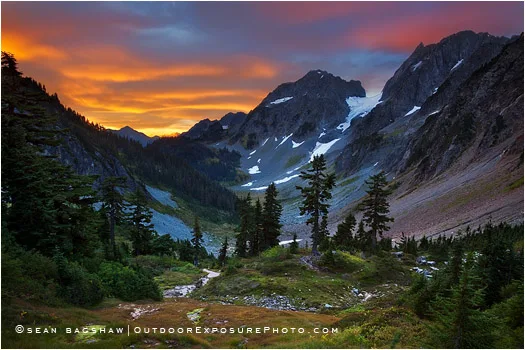
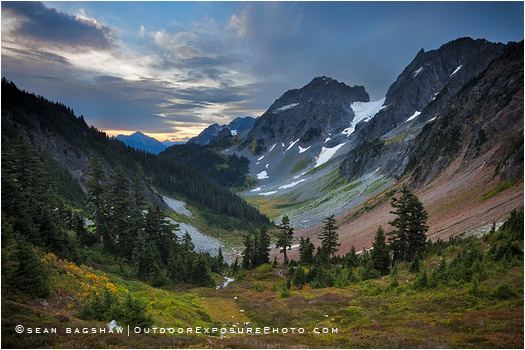
Recently I came across a series of photographs I took during a spectacular sunrise in North Cascades National Park in Washington in the fall of 2010. It was one of those rare occasions in which the event played out over many minutes, allowing me to photograph it several times from slightly different vantage points. While I worked on each image individually I didn’t notice how, as a series, they illustrate the anatomy and progression of light, color and pattern in a way that is hard to share any other way.

This is how that morning unfolded. Chip Phillips, David Cobb and I had camped in a dense wood below Cascade Pass near Sahalie and Pelton peaks and the stunning Sahalie Arm trail. The night before we had been dismayed at the sight of a fallen climber’s body being lifted out of the mountains on the end of a rope beneath a rescue helicopter. It was still replaying in my dreams when Chip rose at 3:00 AM with the intent of hiking high above the pass before sunrise. David left camp second, about an hour later. I was last out of camp and wasn’t far up the trail when the sunrise light began to show itself.

Cursing myself for sleeping too long, I made this photograph along the trail still low in the valley in near darkness. The first light was just beginning to illuminate the clouds and the dark features of the land. A long 15 second exposure at f/13 and ISO 640 recorded the dim landscape much brighter than it appeared to the eye. A second exposure of just 4 seconds captured a good exposure for the sky and the properly exposed areas of each were blended together using layer masking techniques.

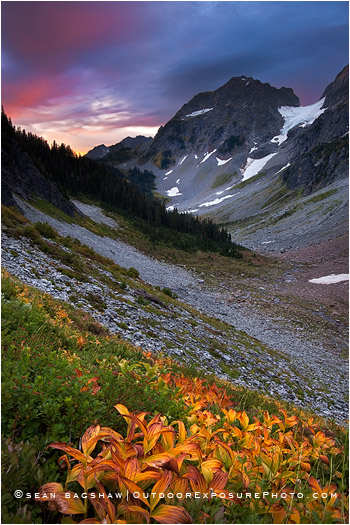
Aware that the best light would come rapidly and that I wasn’t in the ideal location, I ran up the trail, stumbling in the dark and breathing hard. The color intensified and I frantically searched for something to anchor the foreground of my next photo. I found a small mountain ash tree turning red with the coming autumn. At the same time I noticed the stream in the valley beginning to reflect the red-orange of the warming sky. Radiant light reflecting off the undulating under surface of the clouds back lit the foliage making it appear to be glowing from within. This wide angle, vertical composition turned out to be my favorite from that morning. I titled it Unforgettable Fire and it is now part of my print collection.

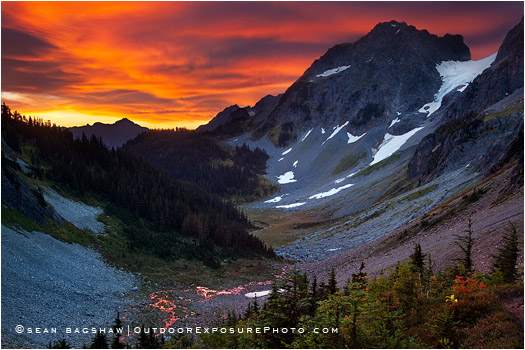
Satisfied that I had managed to take a good photo despite my late start I relaxed a bit. However, to my surprise, the color showed no signs of abating. I continued up the trail looking for other perspectives from which to photograph the scene. I scrambled around, struggling to find a composition as compelling as the last. While I didn’t find another that felt as good, I kept stopping to shoot because the color in the sky continued to spread and intensify, accentuating the shapes in the clouds. In this image the brilliant reds and oranges overpower the rest of the scene.

Further along my ascent of the pass the colors began to shift from deep reds to lighter oranges and yellows and cool light began to filter through the cloud layer from above.

Finally, as the day brightened, the sun rose above the cloud layer. The under-lighting faded along with the color, leaving the clouds flat and gray from below but giving a glimpse of blue sky and higher clouds above.

That morning, as well as many others, have become important and indelible parts of my consciousness. Through photography I have become better at being acutely present and attentive during such magical twilight events, making them that much richer, meaningful and memorable. Having the photographs as keepsakes gives me the opportunity to relive the experience and see it again in ways I wasn’t able to as I witnessed it.

Filed Under: Featured Photos, Photography Journal Tagged With: landscape photography, National Park Photography, photography technique, Twilight Photography

Available Light Images Podcast Interview

August 24, 2011 by Sean Bagshaw Leave a Comment

Available Light Images Podcast Interview

Wow, I have really neglected my blog this summer. I put it down to a combination of focus on other projects, writing for other blogs and the opportunity to spend some quality time with my family during summer school holidays. I have plenty of great photography content to share so I just need to get back in the groove.

I can start out by sharing a podcast interview I did this summer with the talented and insightful Alister Benn at Available Light Images. Alister hails from Scotland, lives in Spain and travels the world with his wife from China making stunning photographs. Alister’s photographic talent combined with his enthusiasm for adventure, natural beauty and ambitious photography related projects make him one of the most intriguing new voices in contemporary photography. Add to that his really cool Scottish accent and he’s the full package. In July we sat down over a Skype connection and had a great chat in which Alister interviewed me about everything from artistic philosophy to cutting edge digital image developing techniques. I had a great time talking with him and appreciated his thorough and insightful questions.

You can listen to my conversation with Alister here.

He also has podcasts of interviews with two other talented photographers:

Guy Tal is one of my favorite contemporary photographers and writers from the American west. Few people speak on the topic of fine art photography as well as Guy. You can listen to Guy’s podcast here.

David Clapp is a British Photographer with a great reputation for superb images of many diverse subjects from Architecture, Travel & Culture, and of course, contemporary Landscapes. You can listen to David’s podcast here.

Filed Under: Interviews, Photography Journal

New Article On The PhotoCascadia Blog: Searching For What Is Not Literally There

July 14, 2011 by Sean Bagshaw 2 Comments

My most recent article on the Photo Cascadia blog explores the challenge photographers face in translating experience, inner vision and “voice” in a way that they still resonate within the static, two dimensional photograph. Ansel Adams’ advice to look beyond what is literally there and instead identify something from within you that draws you to the scene has been very helpful to me. To make our photographs more than just pictures of things it helps to identify the qualities of a scene that stimulate us and allow that information to guide what the photograph should really be about.

You are invited to read the entire article on the PhotoCascadia blog.

Filed Under: Photography Journal Tagged With: fine art photography, photo cascadia blog, photography techniques

Trip Report: Photographing Oregon's Owyhee Country

May 17, 2011 by Sean Bagshaw 6 Comments

Trip Report: Photographing Oregon's Owyhee Country

Malheur County may be one of the least known and least visited parts of Oregon. It is located in the extreme southeast corner of the state bordering Idaho and Nevada. Geographically it is one of the largest counties in Oregon with a total area of about 10,000 square miles, but it has one of the lowest population densities at just 3 people per square mile. Most of the population is centered around Ontario and Vale in the northern 15% of the county. Almost everything to the south is open range land managed by the BLM. There is just one paved road, Hwy 95, and one town, Jordan Valley.

But out in the arid scrub and ranch land of Malheur County lies the Owyhee River. The Owyhee drains a remote area of the high desert plateau on the northern boundary of the Great Basin and flows northward to the Snake River. The various arms and tributaries of the Oywhee cut deep canyons through the Owyhee Plateau, many with vertical rock walls that in places can be over 1,000 feet deep. 120 miles of the Owyhee River Canyon were designated as Wild and Scenic in 1984.

The southern reaches of the river can only be accessed by dirt roads, some fairly well maintained and others not more than jeep tracks. Even then there are just a handful of spots where it is possible to reach the river by vehicle. Most of the Owyhee and it’s tributaries can only be explored by backpacking or rafting.


People have been suggesting I check out the Owyhee country for years. As it is not along any usual route of travel and many hours from just about anywhere I had never visited this part of the state until this spring. I went to do some exploring and take some photos with fellow photographer, David Cobb, who had previously hiked and photographed portions of the river.

Finishing the morning shoot at the Cliffs of Rome.

I was absolutely drawn in by the beauty and scope of the canyons and the surrounding high desert. Along the drive south from Ontario the dirt road first takes you through Succor Creek Canyon which is just a small preview of what’s to come, but very scenic in its own right.

Succor Creek Canyon

Leslie Gulch is the main attraction along the Lake Owyhee reservoir and provides the easiest access to the river in this area. Throughout the gulch and all along Lake Owyhee the rock spires and escarpments are very reminiscent of Smith Rock State Park only, as David says, “on steroids”. We explored the main Leslie Gulch road and made a couple of forays up side canyons. The area to the north known as the Honeycombs looks particularly enticing but can only be reached by backpacking in or taking a boat over from the west side of the lake.

North of the town of Jordan Valley you can follow the Jordan Craters Road for about 30 miles into a large lava flow that originates at the Coffee Pot Crater.

Coffee Pot Crater

Spatter Cone at Jordan Craters
View from inside a spatter cone

Continuing on a side road from there you can wind your way down steep switchbacks and reach the river at the historic Birch Creek Ranch. This is one of the main takeouts for rafters floating the river.

Cliffs at Birch Creek Ranch
Birch Creek Ranch

Southwest of Jordan Valley is the community of Rome. Near Rome there are several dirt roads that offer access to the river canyon as well as the nearby Cliffs of Rome and Chalk Basin further to the north.

Pillars Of Rome

South of Hwy 95 between Rome and Jordan Valley, Three Forks road makes it’s way across about 30 miles of high desert to join the Owyhee River at Three Forks. David and I were glad to have my 4×4 for this road as we found it heavily rutted after winter rains. We also had to make about three creek crossings, the deepest of which engulfed my front bumper. From the map we saw that we could stop along the road a few miles north of Three Forks and hike out the the canyon rim. Photographing a roadless portion of the wild and scenic Owyhee at sunset sounded appealing, but after a few steps off the road we discovered ticks clinging to our pants. Despite giving David a serious case of the willies we continued on and were able to access a sweeping vista of the canyon before sundown. By the time we completed our hike back in the fading light we had found over 100 ticks between us! A strip search in the headlights revealed several more. I managed to find all of the ones on me, but David found several more lurking on him during the night and didn’t get a wink of sleep.

David trying to ignore the ticks

Three Forks is a popular put-in for rafters and the presence of hot springs make it an attraction for others as well. My main interest in returning to Three Forks is that this is where the adventurous backpacker can access the branching web of the upper Owyhee Canyon and it’s various tributaries. Radiating out from the Three Forks area are no less than six deep and narrow canyons including the Big Antelope, Louse and Middle Fork.

While I was able to take some exciting photographs on this scouting trip I am excited to get back soon. Future trips will include spending several days rafting and photographing the Owyhee proper as well as doing some back country packing up the tributary canyons south of Three Forks.

Filed Under: Photography Journal, Photography Travel Journal Tagged With: landscape photography, Oregon Photography, outdoor photography, southern oregon photography, travel photography

Image Developing Workshop Review

April 15, 2011 by Sean Bagshaw 2 Comments

Steve Cole, a photographer based in Washington, recently attended two of my digital image developing classes in Bend, Oregon. Steve is serious about photography and has spent a lot of time researching techniques and developing his skills. He drove to Bend from Seattle hoping that he could add some new techniques and skills to his repertoire.

Steve, it turns out, is also a very good writer. After the class he was motivated to pen a detailed review of the classes. His description of what goes on during the class and what content was covered is better than I could do myself. For a well written, unsolicited overview of what we were up to in Bend I encourage you to give Steve’s article a read.

Here is a short excerpt. “So were the two classes worth it? Without hesitation, I can say YES. From the minute you first meet him, Sean is friendly and engaging without any elitism or arrogance. He is just a guy who is passionate about nature and photography and who doesn’t love that? Before becoming a “pro” photographer 8 years ago, Sean was a middle school teacher and that really shows in his ability to teach and explain concepts.”

As Steve says in the article, I haven’t yet scheduled these classes again in the near future. If you have a venue and a group of 10 to 15 people who are interested give me a call.

Steve’s Blog: scolephoto.blogspot.com

Steve’s Website: www.scolephoto.com

Filed Under: Photography Journal Tagged With: digital photography, digital workflow, Exposure Blending, nature photography, photography workshop

On Landscape Photography, Digital Image Developing and Artistic Expression

February 28, 2011 by Sean Bagshaw 4 Comments

On Landscape Photography, Digital Image Developing and Artistic Expression

One of the mindsets that guides my photography is that the human eye and the camera don’t experience the world in the same way. Photographs are more limited than human sight in many ways, but can also see in ways that we can not. It is my goal to understand what the camera sees so I can manipulate and coax it to capture a photograph that reconciles with my own view of the landscape. To some this goes against tradition. We have been conditioned to believe that a photograph portrays, or at least should portray, an accurate record of the world and we must accept what the camera gives us. In truth, the very act of taking a photograph significantly alters a scene from how we perceive it in any number of ways. I’m less interested in the literal and more interested in what I can communicate and create. Artists have always endeavored to express themselves, their experiences and their impressions through their medium. A camera is a tool to do just that, to paint an artistic vision of the world. I want to capture something that excites me and hopefully resonates with others. In a recent interview my friend, professional musician and fellow photographer, Chip Phillips said, “The main thing to make the [musical] performance successful is to stir up an emotional response in the listener, and the same is true with a photograph.”

Both the way that we capture and develop our images have entered a new and exciting phase. Early on I embraced the changes digital technology brought to the art form. The digital age has allowed photographers to overcome many shortcomings and limitations of cameras that have frustrated them from the beginning. The new tools of photography enable me to be more creative and to express my experiences and vision more fully than ever before. I will always be fan and a student of traditional landscape and nature photography, venturing into the land to work with the raw materials of light, form, color and texture. And while the photographic tools and techniques are evolving, the motivation and the thought processes of the nature photographer remain unchanged. If anything, I find that it is more important than ever to be on top of my game. It takes skill in traditional photography techniques as well as skill in digital developing to get my images to approach what I hope for them.

There are those who worry that digital photography has lowered the bar. I can say my experience has been just the opposite. All the principles of light and composition continue to apply and proper camera technique is still essential. In fact, the way that I work with the camera in the field these days is more involved and creative than it ever could have been with film. I shoot thinking several steps ahead to how I will want to develop the image later on. In just a few seconds I might capture a range of frames utilizing different exposures, apertures and focal points in order to collect all the visual information in the scene I’ll need to develop the finished piece. Learning how to think and work with so many variables while simultaneously pre-visualizing the future processing has been far more interesting and challenging than working within the confines of a single frame of film ever was. Far from being a shortcut or a creativity killer, digital photography allows us to express a new and exciting vision, not unlike the way film photography did when it was introduced over a century ago.

For further musings on the topics of photography, artistic expression and where current digital developing techniques come to bare I would point you toward Guy Tal’s recent article: Lie Like You Mean It.

There are so many great activities one can be involved in in life. For many of us, one of those activities is the magic of exploring the world with our cameras in hand, capturing moments and trying to make lasting memories of the scenes that impress upon us.

Links that might be of interest:

Upcoming image processing classes and outdoor photography workshops.

Instructional videos on fine art image processing.

In my photography I am aware that the human eye and the camera don’t see the world in the same way. Photographs are more limited than human sight in some ways, but can also see in other ways that we can not. Since its invention we have been conditioned to accept that photography portrays a “literal” record of the world. However, as an artist, I’m less interested in the literal and more interested in how I can communicate my own experience and personal artistic vision. Artists have always endeavored to express themselves, their experiences and their impressions through their medium. My challenge is to use the camera to do just that, to paint an artistic vision of the world as I see it. I strive to do it well enough that it resonates with others.

I am a fan of traditional landscape and nature photography. I derive great pleasure from venturing into the land and working with the raw materials of natural light, form, color and texture. The earth is my palette. But I also want to go beyond photography as a mere technical pursuit or objective record of natural history. In my photos I struggle to express something beyond a literal representation of the scene. Through the use of traditional photography techniques as well as careful digital developing I struggle to project my own human impressions, experiences and imagination. I hope that those who view my images are able to experience the same sense of adventure, mystery, drama, exploration and beauty that I do when I am out in the world.

Photography has entered a new and exciting era. Early on I embraced the changes digital technology brought to the art form. The digital age has allowed photographers to overcome many shortcomings and limitations of cameras that have frustrated them from the beginning. It is an exciting time to be a landscape artist. The new tools of photography enable me to be more creative and to express my experiences and vision more fully than ever before.

For those wondering if digital cameras have lowered the bar in photography, I can say my experience has been just the opposite. All the principles of light and composition continue to apply and proper camera technique is still essential. In fact, the way that I work with the camera in the field these days is more involved and creative than it ever was or could have been with film. I shoot thinking several steps ahead to how I will want to develop the image later on. In just a few seconds I might capture a range of frames utilizing different exposures, apertures and focal points in order to collect all the visual information in the scene I’ll need to develop the finished piece. Learning how to think and work with so many variables while simultaneously pre-visualizing the future processing has been far more interesting and challenging than working within the confines of a single frame of film ever was. Far from being a shortcut and creativity killer, digital photography allows us to express a new and exciting vision, not unlike the way film photography did when it was introduced over a century ago.

Filed Under: Photography Journal Tagged With: digital photography, digital workflow, fine art photography, landscape photography, oregon photographer

Exploring Hart Mountain Wildlife Refuge In Winter

February 23, 2011 by Sean Bagshaw 2 Comments

Exploring Hart Mountain Wildlife Refuge In Winter

Admittedly, winter is not my most prolific photography season. Cold, darkness and unpredictable weather often get the better of my psyche and I find myself making excuses or prioritizing office work. However, once or twice a winter I do manage to gear up and head someplace windswept and snowy with my camera. This winter Chuck Porter, one of my oldest and best friends, and I spent a couple days exploring the lonesome high desert in the Hart Mountain Antelope Refuge. Back when we were more energetic Chuck and I spent a lot of time climbing cliffs and mountains all over the western US and spurring each other on to complete questionable feats of endurance. Once we hiked the entire length of the Wild and Scenic Rogue River Trail, all 40 plus miles, in a day. Another time we climbed Mt. Shasta, Mt. McLoughlin and Mt. Thielsen in a 21 hour push. These days we are happy just to get out and camp for a weekend and do a little ski touring.

Hart Mountain National Antelope Refuge is a national wildlife refuge on Hart Mountain in southeastern Oregon, which protects more than 422 square miles and more than 300 species of wildlife, including pronghorn antelope, bighorn sheep, mule deer, sage grouse, and redband trout. The refuge, created in 1936 as a range for remnant herds of pronghorn antelope, spans habitats ranging from high desert to shallow playa lakes, and is among the largest wildlife habitats containing no domestic livestock. Located in a remote region of southeastern Oregon at an elevation over 6,000 feet, Hart Mountain is a wild and desolate place any time of year. In winter, blanketed by snow, it becomes a quite and seemingly endless surreal landscape.

During our visit, Chuck and I skied through a couple of different areas, both very small in the total scale of the refuge. We talked about coming back one winter and skiing all the way across, but we’ll see if I ever get the winter motivation to take that on. The two areas we explored on this visit were the hot springs basin below Warner Peak and Petroglyph Lake. Petroglyph Lake is sheltered on one side by a low cliff band that houses several panels of Native American rock art.

Instead of going on at length about the skiing, sleeping in the car, eating bad food and all the other standard tales from a trip like this I’ll just let the photos speak for themselves. You can click on each image to see it larger and then hit the back button to return to the article.

Hart Mountain rising out of the clouds above Hart Lake.
Old building at park headquaters.
Winter Landscape
Rok Chuk
Hotsprings basin black and white
Meandering hotsprings stream
Skiing toward Petroglyph Lake
Desolate and windswept
Warner Peak above the high desert plain
Skiing around Petroglyph Lake
Petroglyphs
Petroglyphs
Petroglyphs
Wind sculpted snow
Skiing in a snow shower

Filed Under: Adventure Journal, Photography Journal, Photography Travel Journal Tagged With: landscape, landscape photography, nature photography, oregon photographer, Oregon Photography, outdoor photography, sean bagshaw, travel photography

My Favorite Images From 2010

January 3, 2011 by Sean Bagshaw 25 Comments

My Favorite Images From 2010

Despite their ubiquity this time of year, I always look forward to year end reviews in which we, as a society, look back at the previous year and what came of it. There is something intrinsically valuable about the practice of remembering the year gone, both personally and as a community. I appreciate the sense of closure it gives; a sort of taking stock and clearing of the air, a brief pause before barreling toward the future again. We do this for all aspects of life. The media loves to inundate us with lists and images recalling the year in politics, movies, economics, environmental crises and sport. Many of us take stock of what our personal lives brought in the past year as well.

Like many of my photographer colleagues, much of my year is wrapped up in the places I traveled and the photographs I made. Much effort and time is spent in pursuit of those few defining images that rise above the rest. They alone tell the story of my success or failure to communicate the vision I strive to capture and share. Despite success or failure, it is really about going for the ride. Whatever the outcome I take heart in adding another year to my photography story.

With those thoughts in mind I share some of my favorite images taken in 2010. Enjoy.

Camino de Oro
Camino de Oro, Guanajuato, Mexico
Lost In A Winter Forest, Crater Lake, Oregon

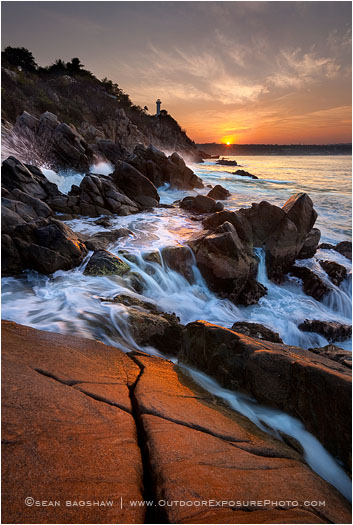
Copper Coast, Puerto Escondido, Mexico
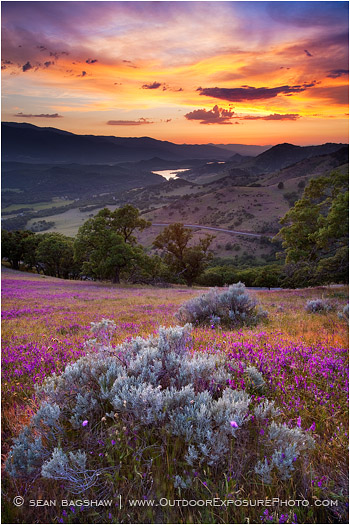
Shasta Lavender, California
Sparks Lake Columbine, Oregon
Twilight Grove, Redwood National Park, California
Unforgettable Fire, Cascade Pass, Washington
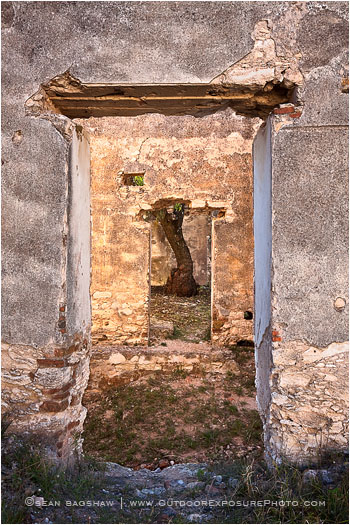
Mineral de Pozos Doorways, Mexico

Teardrop Of Sky, Bandon, Oregon
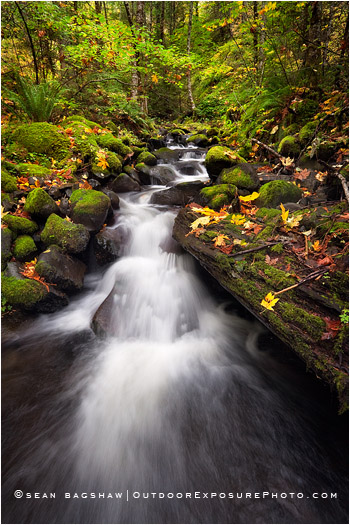
Starvation Creek, Columbia Gorge, Oregon

Thanks for looking. I’d love to read any comments questions you might like to share, so please post those below. If you’re feeling it, please share this blog on your social media site of choice. Here’s to 2011!

Filed Under: Featured Photos, Newest Fine Art Prints, Photography Journal Tagged With: fine art photography, landscape photography, nature photography, southern oregon photographer

Exposure Blending Techniques In Landscape Photography

December 16, 2010 by Sean Bagshaw 7 Comments

Exposure Blending Techniques In Landscape Photography

I recently published an article on the Photo Cascadia blog discussing some of the basic exposure blending techniques I use. Exposure blending is the processing technique I get asked about more than any other, and this is the topic most requested in my digital image processing classes.

Greensprings Sunset

So, what is exposure blending? Simply put, it is a method of combining the best exposed portions of two or more exposures of a scene to maintain detail and balance in the brightest and darkest areas. Camera’s have serious limitations in their ability to “see” wide ranges of light. Scenes with a fairly narrow range of light can be captured in a single exposure. But in many dramatic natural light situations the range of light from the brightest areas, like a sunset sky, and the darkest areas, like a shadowed canyon in the foreground, are far outside the ability of film or digital sensor to record all at the same time. This is in contrast to our own eyesight which is able to see a very wide range of light.

For this reason, many of the dramatic light photos people try to take have sky that is completely overexposed or white and landscape that is completely underexposed or black. These images never live up to the way that the person taking the photo experienced the scene and often evoke the disclaimer, “it looked way better than this when I took it”. Since the invention of photography in the 19th century photographers have tried to compensate for this shortcoming. Traditional film photographers developed a long list of techniques, both in camera and through darkroom processing, to try to create images of high light range scenes that matched what they could see. Digital cameras and the ability to process images using computers have now given photographers the best options for dealing with this problem. It is possible to take multiple exposures of a scene in camera, exposing each image for a different part of the light range, and then combine the properly exposed portions of each into one final image. The product is a photograph that has light balance and shadow and highlight detail that more accurately expresses our vision. Photographs that would previously have been impossible are now possible, although not without some effort, skill and artistic vision.

Rowena Hills

There are automated software solutions, known as High Dynamic Range (HDR)software, that can blend multiple exposures automatically, making it possible for even the most amateur photographers to combine exposures and create high dynamic range images. The most current versions of Photoshop have HDR software built in. Other popular HDR software includes Photomatix, Nik HDR Efex Pro, and UnifiedColor HDR Expose. Currently, however, all the software solutions I have tried create quality issues for someone like myself whowants to create large fine art prints. They allow very minimal local control over the effects they create and often produce a very cartoonish or glowing look that may or may not be what is intended. Most problematic to me are the color shifts, low contrast and digital artifacts that can be introduced by HDR software. For these reasons almost all of my exposure blending is done using hand blending techniques with layer masks in Photoshop.

These techniques are an art form in their own right, taking years to master and greatly increasing the overall difficulty and level of skill required in the photographic process. The exciting part is that the creative control that darkroom masters such as Ansel Adams had, and that was largely lost in the era of color film, has now back in the hands of the photographer. Marc Adamus sums up the challenge and value of this approach eloquently on his website stating, “My process in the field today is more difficult, more complex and more creative than it ever was or could have been with film…to think about this all in the field and bring back the right exposures to fulfill my vision of the scene has taken considerably more practice than learning how to use a colored or graduated filter in the film days, and has also opened new creative avenues. Anyone who thinks of digital photography as a ‘crutch’ of sorts, simply does not understand these processes and the precision with which they must be executed in-camera as well as in processing.” Marc does such a good job communicating the ways that many contemporary photographers work that I would encourage you to read his entire artist statement if you have the time.

Deep Forest

If you are interested in learning more about the basic concepts and techniques behind exposure blending I would recommend reading my articles, Bracketing Exposures For Exposure Blending and The Basics Of Exposure Blending. I also offer classes on exposure blending as well as private instruction.

I’d love to hear your comments related to this topic. If you are an outdoor photographer, is this a technique that you use? What are your experiences with it? If you are not a photographer, what are your impressions such contemporary photography techniques? Please feel free to leave me a comment or share this article using the social media links below.

Filed Under: Photography Journal Tagged With: digital photography, Exposure Blending, photography technique

Cascade Pass

September 18, 2010 by Sean Bagshaw Leave a Comment

Cascade Pass


Cascade Pass

Originally uploaded by Sean Bagshaw

I had an amazing week in the North Cascades with fellow Photo Cascadia members David Cobb and Chip Phillips. The sunrise on our first morning at Cascade Pass was spectacular. Chip went out with his camera at 4 AM and was able to make it all the way up to the Sahalie Arm from the Pelton camp by sunrise. Go to Chip’s photostream to see his image. David was next off at about 5:40 AM and made it up to the pass. I was last out and had to scramble to find a composition below the pass before the sky show was over.

Filed Under: Photography Journal

Photo Cascadia Q&A

March 9, 2010 by Sean Bagshaw Leave a Comment

Last week a team of Pacific Northwest photographers, including myself, launched the website for and officially announced our group photography project called Photo Cascadia. The launch of Photo Cascadia was met with excitment and interest from friends, colleagues and the photography enthusiast community in general. If you missed it, you can read my previous post for the basic introduction to the Photo Cascadia team.

The launch of Photo Cascadia also generated some great discussion and several questions about the future plans of the group. Group founder, Adrian Klein, has posted answers to the most common questions about the group that we have recieved to date. Perhaps they are questions that are on your mind as well. Questions include:

  • There are few groups out there already that have collaborated on websites and other efforts in relation to Nature Photography.  What makes your team different and how was it started?
  • Why is the Photo Cascadia team all males? Where are the female photographers?
  • Does the Photo Cascadia team have Photo Cascadia specific workshops available?
  • How can I buy fine art prints of images I see in the Photo Cascadia galleries?
  • When will the Photo Cascadia team have additional products available for purchase such as calendars, books, cards, etc?

Read Adrian’s Q&A for answers to these questions and to submit any other questions you might have about Photo Cascadia.

Filed Under: Photography Business, Photography Journal, Uncategorized Tagged With: fine art photography, Photo Cascadia, Photography Workshops

Subterranean Guanajuato

January 22, 2010 by Sean Bagshaw Leave a Comment

Subterranean Guanajuato

Guanajuato, Mexico is as visually interesting as any city I have photographed. What many visitors might not realize, however, is that to find some of the most surreal parts of town you have to go underground.

The entire city sits atop an extensive subterranean tunnel system. The tunnels were originally dug by mining operations starting in the 16th century to divert the river and keep the town and mines from flooding.

From its beginnings in the mid 1500s the city was built to maximize useable space on the steep hillsides. Houses were stacked on top of one another with only the narrowest of alleys between them. Much of the charm of Guanajuato comes from the fact that it was never intended to accommodate cars.

But cars were inevitable. In a huge engineering project in the 1960’s, as car traffic in the narrow streets became more of a problem, the river was diverted yet again and the tunnels were converted into an underground system of roads. New tunnels have since been added, creating an ever expanding underground even Batman would be envious of. Drivers who know and understand the complex catacombs can quickly get from one part of the city to another. There are many entry and exit points making it possible to dive underground in one neighborhood and surface in another the next valley over.

Most of the tunnels are deep underground, dark and full of car exhaust, but in places they break out to the surface where they are lined with buildings, bridges and arches.

The subterranean channels and tunnels create an entirely different and mysterious dimension to a town that already has so much interesting character. It is a little hard to locate the best parts of the subterranean tunnels at first, and it can also be very disorienting trying to navigate through the tunnels. Often I’ll emerge in a part of town that I have never been in before.

If you enjoyed this photo essay consider sharing it on your social media network of choice using the handy links below.

Filed Under: Photography Journal, Photography Travel Journal Tagged With: fine art photography, Guanajuato, Mexico, night photography, travel photography

Doors And Windows of Guanajuato

January 21, 2010 by Sean Bagshaw 6 Comments

Doors And Windows of Guanajuato

One of my favorite photography projects in Guanajuato is exploring the callejons (narrow alleys) in search of interesting doors and windows. Many of the home owners in this town take great pride in their houses. Bright colors are popular and particular attention is paid to doors and windows. While some doors are kept carefully, other doors are neglected and have an authentic patina of time.

With a rumored two thousand callejons in the city, all lined with buildings, there is no lack of doors and windows. Every door is different. Some are pristine, with carved and crafted hardwood and hand forged metal parts. Others are weathered and full of character. Some are precariously set in crumbling stone and brick and covered with graffiti. Each one tells its own story.

As a photographer, I love the way light is reflected at different times of day in Guanajuato. The alleys are narrow enough that they transmit light in a way similar to a desert slot canyon. Direct sun striking the upper reaches of a deep alley can bounce back and forth off of the buildings, projecting a soft, radiant light deep into the shadows. A fully lit alley wall can also reflect a very strong glow onto the adjacent wall or around corners.

The light is constantly changing, so part of my challenge is to find doors and windows that have special character and then return to photograph them when they are illuminated by particularly intriguing lighting conditions.

These are just a few of the door and window photos I have taken on this visit so far. I also took a bunch last time I was here and I’ll probably photograph some more before I leave. I’m not sure what I’m going to do with all the door photos. Photographing them is mostly a compulsion. I suppose I’ll publish some of the best ones on greeting cards. I have also had requests for a “Doors of Guanajuato” poster, which I think is a pretty good idea.
If you enjoyed this photo essay consider sharing it on your social media network of choice using the handy links below.

Filed Under: Photography Journal Tagged With: fine art photography, Guanajuato, light, Mexico, photography technique, travel photography

Guanajuato City Scenes

January 17, 2010 by Sean Bagshaw Leave a Comment

Guanajuato City Scenes

An important element of photographing while traveling in other countries is the ability to take what comes. Last Saturday I carefully penciled out my shooting schedule for the next three weeks in and around Guanajuato, Mexico. That night I came down with some sort of stomach ailment that confined me to bed until Wednesday. While feeling much better a week later, I’m still regaining my strength and can’t wander too far from a bathroom. As a result I didn’t get nearly as much photography done as I hoped and now I need to adjust my plans. But that’s OK. There are some things you can’t control when in another country.

Pink House on Calle Tecalote

As my condition improved through the week I went out to take photos as I was able. The weather has remained mostly cloudy and a bit drab, but there have been moments of the brilliant light that that Guanajuato is known for.

The unusually cold and wet conditions reminded me of some tips for making the best of urban photography at times when the weather is less than ideal. First, since cities provide their own light, twilight and night photography are opportunities for great light even when the weather is poor. There are two periods each day, around sunrise and sunset, when cities come alive with their own light, even on overcast days. During twilight a dull gray sky will appear blue while city lights glow in a variety of colors. A second tip is to be prepared to move quickly during weather breaks. I was able to quickly jump into action a couple of times when sun broke through the clouds for brief periods. The photo ops didn’t last long, but the light was particularly dramatic.

Brief Sunbreak at Sunset

The images in this post are of city vistas and of some of the notable landmarks around Gunajuato. I took them either in twilight or night time lighting conditions, or during a few breaks in the cloudy weather. I hope you enjoy.

Templo San Diego
Templo San Diego
Basílica de Nuestra Señora de Guanajuato
Teatro Juárez
Teatro Juárez
Iglesia de San Francisco
Stormy Sunrsie
Stormy Sunrise

Filed Under: Photography Journal Tagged With: Guanajuato, light, night photography, photography tip, tips, travel photography

Rain In The City Makes Magic

January 10, 2010 by Sean Bagshaw Leave a Comment

Rain In The City Makes Magic

Plaza de la Paz
Plaza de la Paz, Guanajuato

Normally I get a little bummed when I get up early for photo shoot to find it raining. But on our second day in Guanajuato I was perfectly happy with the light drizzle. Night cityscape photography is just about the only time I like to shoot in the rain. The mix of colorfully painted buildings and well lit callejones (alleys) in Guanajuato make night photography here particularly beautiful anyway. But one thing that can enhance that beauty is if the cobbles are wet, causing them to shimmer, reflecting the color and light.

Calle Tecalote in the Rain

It wasn’t raining hard, but I still got thoroughly soaked as I wandered around the streets in the dark. Keeping the camera lens dry was also a challenge, especially for the 20-30 second exposures that were required while using a circular polarizer and an aperture of f/16 in low light. In the northwest US, rain is common enough that there are usually awnings or covered entries to hide under when shooting cityscapes in the rain. Not only are awnings rare in this arid part of the world, but most buildings don’t even have any sort of eaves to hide under. I was only able to take a few images before my gear and I were wet enough to call it a morning. Still, I’m excited about the images I did get and hope to have another chance to photograph in the rain while I’m here. On the other hand, I might give up that chance if it meant I could get some warm, sunny weather. I’m layered up and freezing at the moment since the houses don’t have insulation, double pane windows or weather stripping.

Guanajuato Streets in the Rain

Filed Under: Photography Journal Tagged With: Guanajuato, long exposure, Mexico, night photography, travel photography

Mountain Mining Towns of Mexico

January 8, 2010 by Sean Bagshaw Leave a Comment

Mountain Mining Towns of Mexico

For the entire month of January I’m taking my photography in a slightly different direction and exploring the colonial mining towns of central Mexico. My blog will act as my travel journal. I’ll be posting images and stories about the project here every couple of days.

Guanajuato Sunrise
Guanajuato Sunrise

So, why this particular region of Mexico? Several reasons actually. Guanajuato, the city that I will be based out of, is the sister city to my home town, Ashland, Oregon. The two towns share geographic and cultural similarities. Both are located in valleys in the mountains, both are university towns and both have theater festivals and strong art culture. Since the two towns became “sisters” there has been a continuous exchange of students, teachers, musicians, artists and city leaders. My wife has been coming here for several years to attend Spanish language school. This year our sons are old enough to begin taking Spanish lessons, so we decided to move the entire family down for a month of language immersion. I made a short trip to Guanajuato about three years ago and fell in love with the photographic potential of the architecture, character and beauty of the town. During this more extended stay I hope to do the kind of in depth photography that comes with familiarity with a place and also travel to some of the other towns and environs in the region.

Early colonists came to the mountains of central Mexico to mine for metals and minerals. The towns are often built on steep hillsides in narrow valleys. In Guanajuato, most of the roads are in tunnels beneath the city and the town is accessed via pedestrian streets and very narrow and steep alleys. The colorful houses are stacked upon each other like a big game of tetris and the alleys can be almost as narrow, deep and winding as slot canyons in Utah. Needless to say, Guanajuato and the other mining towns in the region are popular with photographers.

Calle Potrero
Calle Potrero, Guanajuato, Mexico

My focus this month is to continue the photography that I started on my previous visit and try to create the most beautiful, dramatic and expressive images of the area that have ever been taken. I have a virtual office set up here so I can continue to work and do business via the Internet. Processing images on my laptop is difficult. The lesser contrast, resolution and speed mean that the images I post during the trip will be as good as I can get them, but will be in rough draft form. All of them will need to be remastered when I get home, but hopefully they will give you an idea of what I’m going for.

For those of you who think I’m in Mexico to relax in the sun, not quite. Guanajuato sits almost 7,000 feet above sea level and the average temperature is 62 degrees F. January is the coldest month and temperatures at night can drop into the 30s. Today it is cold and rainy. So, this isn’t a Mexican beach vacation I’m on here. While I like to sit on the beach and surf as much as anyone, the culture, scenery and history of this place will make it a very rich experience of living, learning, spending time with my family and doing my work.

Filed Under: Photography Journal, Photography Travel Journal Tagged With: Guanajuato, Mexico, Mining Towns of Mexico, travel photography

2009 Nature's Best Photography

December 29, 2009 by Sean Bagshaw Leave a Comment

Each year Nature’s Best Photography Magazine sponsors the Windland Smith Rice International Awards, one of the biggest and most highly acclaimed international nature photography competitions. Each year they receive tens of thousands of entries. In 2008 I was very humbled to be chosen as a category winner for my image Lunar Eclipse Over Mt. Shasta. As a category winner, that image was displayed in the Smithsonian National Museum of Natural History for six months. This year I was surprised again to have two of my images receive Highly Honored awards in the competition.

Earth Bound Suns was honored in the Plant Life category,

and Shadow Lands was honored in the Weather category.

In addition to the excitement of being included in the Nature’s Best Awards again, it was also an honor to be represented along with other northwest photographers who I know and admire, including Kevin McNeal, Jon Cornforth and Dennis Frates.

Nature's Best 2009

Filed Under: Photography Journal Tagged With: awards, highly honored photographs, international awards, nature's best photography magazine, windland smith rice international awards

Good Cheer!

December 24, 2009 by Sean Bagshaw 2 Comments

Good Cheer!

Lake of the Woods in Winter, OR

Wishing you wonder, mystery, adventure and good light in the New Year! Thanks for being a part of Outdoor Exposure Photography!

Filed Under: Featured Photo, Photography Journal

Pacific Northwest Photography Podcast Interview

December 7, 2009 by Sean Bagshaw Leave a Comment

Pacific Northwest Photography Podcast Interview

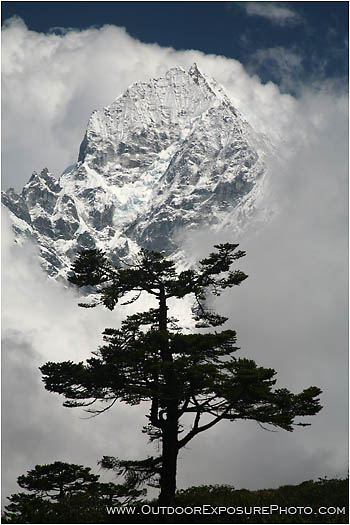
Talented outdoor photographer, Adrian Klein, is now producing a great podcast called Pacific Northwest Photography. Adrian recently interviewed me for his podcast, which you can listen to on the player above. During our conversation we chatted about favorite locations, adventures and photography equipment. I also give the behind the scenes tales of the two images below. You can also get the complete story behind my intolerance of goat flavored food products.
I highly recommend checking out Adrian’s photography at www.adrianklein.com

and his photography blog at http://adriankleinphoto.blogspot.com/

On Adrian’s home page you can subscribe to his PNWP Podcast by clicking the red musical note.
Lunar Eclipse Over Mt. Shasta
Double Falls, Glacier National Park

Filed Under: Photography Journal Tagged With: digital photography, landscape photography, nature photography, northwest photography, oregon photographer, outdoor photography, photography interview, photography podcast, photography techniques, professional photographer, sean bagshaw, southern oregon photographer

« Previous Page
Next Page »

© 2026 · Sean Bagshaw Outdoor Exposure Photography